
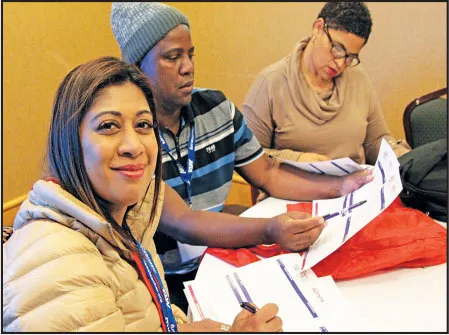
Almost 400 education activists converged on Springfield in early January for the 2020 MTA Union Skills Winter Conference, an event focused on core priorities such as negotiations, employee rights and member organizing.
Participants could hardly find a place to squeeze in for several workshops, including one on wage scales for Education Support Professionals and one on racial justice.
Other sessions during the conference, which was held on Jan. 11 at the Sheraton Springfield Monarch Place Hotel, focused on the Fund Our Future campaign. Some participants attended a workshop titled "Cherishing Public Higher Education in Massachusetts," while others devoted their time to a multisession boot camp designed to provide members of local associations with a working knowledge of municipal finance before Student Opportunity Act funding begins flowing to districts across the state.
The MTA All Presidents’ Meeting was held concurrently with the first block of the conference, allowing local association leaders to attend most of the day’s sessions. Some who attended the MTA Higher Education Conference, held at the hotel the day before, stayed through the Union Skills event.
Locals were encouraged to bring groups of members to participate in workshops based on their roles and interests, and a number did so.
Sandwich Education Association President Chelsea Craig said she and other members of her local attended as a team "to add new skills to our toolbox."
While Craig attended leadership-based sessions to hear from fellow association presidents, other Sandwich members went to communications and technology-based workshops to learn how to best connect with members. "We all chose different sessions that spoke to our needs," Craig said.
SEA member Carly Smith selected a session on contract action teams.
"Being able to tap into how other locals organize made me feel that this was something I could do in my own local," Smith said. "A seemingly insurmountable task suddenly felt achievable and well supported."

At lunch, MTA President Merrie Najimy cut a cake to celebrate passage of the Student Opportunity Act, which will bring additional Chapter 70 education funding to districts over the next seven years. The measure was signed into law in November.
At last year’s Union Skills Conference, Najimy noted, members expressed their solidarity with striking Los Angeles educators. By October of 2019, she said, striking Dedham educators were making their own national headlines.
"Then, with our coalition allies, we won the biggest infusion of money ever — $2 billion — for public schools in Massachusetts," Najimy said. "We are riding that wave right now, and you are doing exciting work in your locals."
MTA Vice President Max Page told the crowd that the Student Opportunity Act was a victory not just for students and educators, but one that has "ricocheted around the country, inspiring others."
Yet there is still work to be done to win passage of the Cherish Act, he said. The legislation would end a long downward spiral in state funding for public higher education, help reduce the amount of debt now placed on students and their families, and address the need to stop the exploitation of adjunct faculty and professional staff.
Page introduced UMass Lowell professors Phitsamay Uy and Sharon Subreenduth, who arrived at the conference with 25 South African educators on a two-week Teaching English to Speakers of Other Languages exchange trip.
Uy, a member of the Massachusetts Society of Professors Lowell, said the group was studying the use of educators’ unions as vehicles for empowerment, advocacy and professional development. "Unions played a significant role in South Africa’s liberation struggle," added Subreenduth.
During the lunch break, Dedham Education Association negotiating team members received a warm reception from fellow educators as they spoke about the local’s strike for a fair contract.
DEA President Tim Dwyer said the solidarity shown by fellow educators and other union members around the state was "enormously gratifying."
Negotiating team member Rachel Dudley said the members’ decision to dig in on issues that truly matter to educators, such as the inclusion of sexual harassment language in the contract, added to the union’s power. "We said, ‘No, we’re not going to let these issues go,’" Dudley told the crowd. In the end, she said, not only was sexual harassment language included in the contract, but training was extended "to everyone — from the administrative team all the way down."
MTA on the Web
Volume 50, No. 3
Winter 2020
Official Publication of the Massachusetts Teachers Association