No matter how you cut it, 2020 has been an annus horribilis, with the COVID-19 pandemic still raging, the rise of white supremacist groups, rampant voter suppression and fires out West driven by climate change. For educators, it has been stressful on all fronts — particularly adjusting to a greatly altered education environment.
"It’s been a slog," said Anthony Parolisi, president of the Haverhill Education Association, speaking in late September on the eve of his 15th memorandum of agreement bargaining session.
Despite everything, a bright spot has been MTA members working together to support their students while standing up for health and safety, fighting furloughs and layoffs, and organizing for the common good.
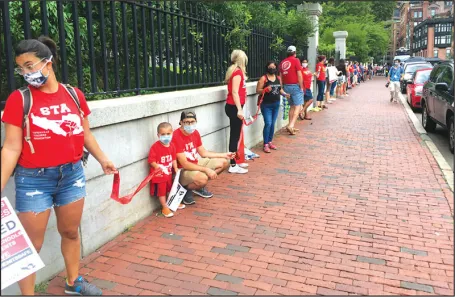
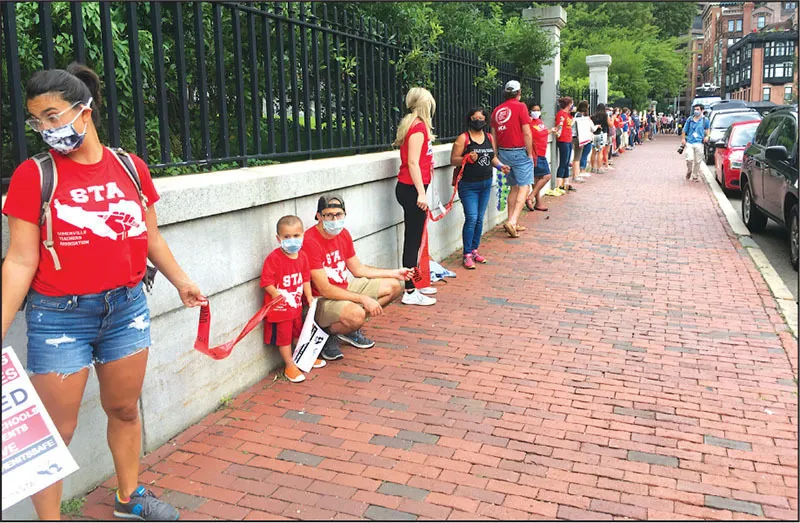
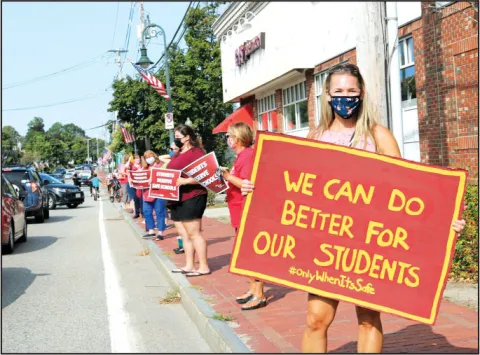
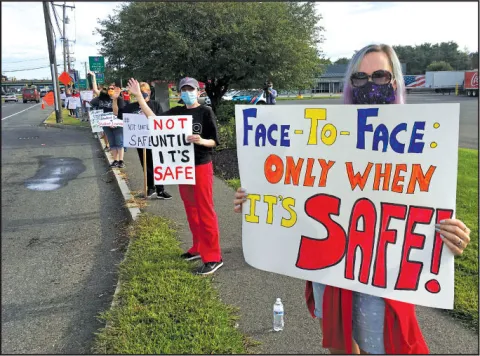
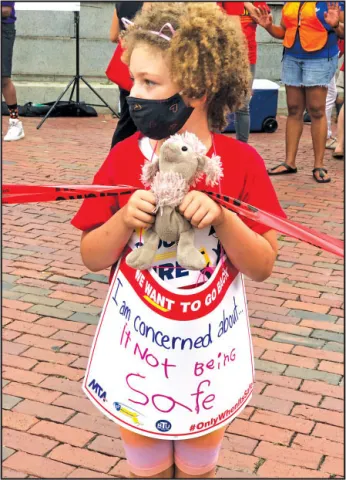
The message of the MTA’s #OnlyWhenItsSafe campaign is that educators want nothing more than to teach their students face to face, but safety has to come first.
"Your actions have made a big difference," MTA President Merrie Najimy said in addressing fellow educators. "You have slowed down the drive to reopen schools too quickly. But we can’t let our guard down. Cases are already on the rise in our schools and across the state. We must act quickly anywhere there are deep concerns about the health and safety of students, staff and communities."
The campaign included rallies on Aug. 19 in front of the State House, in Western Massachusetts and on the Cape. Even smaller events have garnered outsized media attention because of intense public interest.
Parolisi explained the context for the protests.
"We’ve had a failure of leadership at all levels — federal, state and local," he said. "We’ve underfunded our schools for too long. To do this the right way, we need the kind of investment we haven’t seen since FDR."
Here are some stories about member challenges and successes during the pandemic.
Springfield
Lynn Budd, a first-grade teacher in Springfield, said her local association and the district worked together to "get it right" when the school year opened remotely. The groundwork had been laid years before, when the district committed to providing students with laptops. The pandemic accelerated educator training in remote instruction.
"Thank you, MTA, for fighting for the extra 10 days at the start of the year!" Budd said, referring to the agreement the MTA struck with the state to delay the return of students so that educators could have 10 extra planning days. "If we’d only had our usual PD days, it would have been a disaster."
Budd’s day includes both morning and afternoon synchronous teaching sessions broken up with a midday break and asynchronous classes for the students. Fourteen of her 16 students regularly participate, and the school staff is working on the remaining two. An experienced educator, Budd builds in many breaks and makes learning fun. Parents are essential partners, so she spends a lot of time working with them, including developing short explanatory videos.
Despite the long school day, sometimes at the end her students make her laugh by asking to stay on longer. "They want to show me their pets," Budd said. "They’ve been so good."
Budd knows it will be hard to teach reading and writing remotely and is counting on her principal to provide her with extra staff so the students can break into smaller learning communities. For now, though, she is relieved to have gotten off to a good start.
Andover
In Andover, the local was so frustrated with the district’s failure to negotiate over safe conditions or workable learning plans that hundreds of members refused to enter their buildings on the first planning day, Aug. 31. The state ruled the action an illegal strike and members were ordered back into the buildings.
Despite that ruling, Andover Education Association President Matt Bach said the members’ determination persuaded the district to negotiate over air quality issues.
"We had 500 people standing shoulder to shoulder standing up to the boss," said Bach. "That has built more camaraderie than I’ve seen in the 19 years I’ve been here. It’s not clear what will happen next, but we’re in this together."
"To do this the right way, we need the kind of investment we haven’t seen since FDR," said Haverhill Education Association President Anthony Parolisi.
Monomoy
When the MTA negotiated the 10 planning days, Najimy stressed the importance of creativity. In the Monomoy Regional School District on Cape Cod, the local and district embraced change.
Under the district’s hybrid model, English teacher Lisa Forte-Doyle and three other teachers were hired to develop a half-year pass-fail course on "the individual and society" that all students must take. Topics include Black Lives Matter protests, COVID-19 inequities, and bias against members of the LGBTQ community and the disabled.
‘I don’t like sitting in front of the computer all day’
Most of the work is done asynchronously, with students accessing materials developed by the staff. The biggest downsides to teaching remotely? "I don’t like sitting in front of the computer all day," Forte-Doyle said. "I like to be active and moving around. And I miss being around teenagers! I love their energy. I miss laughing with them."
Even so, she was excited to stretch her professional capabilities by helping to create an important new course.
Northampton
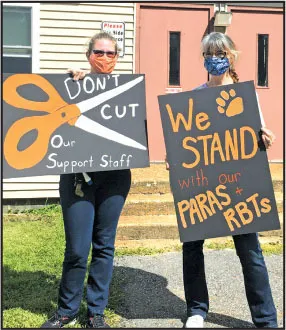
Paula Rigano-Murray heads the unit that represents Education Support Professionals, a member category that refers only to paraprofessionals in Northampton. Since ESPs were not utilized well in the spring, Rigano-Murray said, the local suggested numerous ways that they could make a positive contribution under the district’s remote-learning model. Using ESPs effectively is both good for students and protects the jobs of crucial employees.
Rigano-Murray said the initiative has had varying degrees of success, though the role of ESPs is "eons better than in the spring." In her case, it’s working well. She’s busy from 8:30 a.m. until 2:30 p.m. daily, providing support to learning-disabled students at the high school.
"We managed to prevent layoffs," she said. The next challenge will be finding enough ESPs willing to work in person when the district starts transitioning to hybrid instruction.
Worcester
Joseph Fails, a longtime Worcester history teacher, gives the rollout of the district’s remote plan mixed grades. The Educational Association of Worcester and the district still did not have a memorandum of understanding by Oct. 1, despite local actions including car caravans and member contact with School Committee members.
Fails said that a major sticking point was how to fairly evaluate those teaching remotely when so many had been hired in the paper-and-pencil era. "I feel for the instructor around my age who never really dived into technology as much as I have," he said. "Now they’ve been forced to sink or swim. Some might be sinking."
Fails gets up at 4:30 a.m. to get ready for his first class at 7:20. He said preparing a single remote lesson can take three to four hours, far longer than in normal times.
Even given all those challenges, the situation has its positive aspects. "I get to continue developing my relationships with my students," Fails said. "We talk, we laugh, we joke."
Leominster
Inadequate staffing is a challenge in Leominster, which suffered heavy layoffs in the spring. Despite that reality, the mayor declared on Sept. 29 that the School Committee’s decision to open remotely was causing a "public health crisis."
Leominster Education Association President Leah Burns said educators were "blindsided" by the declaration.
"Our major focus has been on how to get students back in a safe and timely fashion," she said. "But we don’t have the staffing right now to pivot quickly to hybrid or fully in-person."
The local held a large standout on Aug. 19 and is continuing to resist mandates for in-person instruction that cannot be addressed safely.
Hopkinton
Hopkinton opened with a hybrid model, but two positive cases in late September shut the district down briefly — a scenario seen in a growing number of places. Meanwhile, a second wave of infections is widely predicted as the flu season begins to hit.
Becky Abate, president of the Hopkinton Teachers Association, protested a decision by the local Board of Health not to include teachers among those who need to be notified when a student tests positive. The board ultimately agreed to increase the pool of teachers who are informed.
Despite the problems, Abate said her eighth graders have been great. "Kids are so much better able to adapt than adults," she said. Yet she cautioned: "Kids who struggled with anxiety and executive functioning before are still having those issues, probably at an elevated level."
Abate said her students were being responsible about wearing their masks in school. Keeping them at a distance from one another in the halls is much harder, however, since many students were used to hanging out with their friends over the summer.
A third positive case was identified in early October, so the challenges continue.
Hybrid vs. remote
Of all the models, the most challenging is the one in which educators are required to teach students in person and remotely at the same time. In response to a Facebook post on this subject, more than 560 comments flooded in. One writer noted, "The educational experience is diluted for both groups."
A second stated, "I teach high school but I get kicked out of the Google Meet at least once almost every day. I had to buy my own microphone because they couldn’t hear me clearly through my mask and Chromebook. Kids all turn video off so it’s hard to know if they are there or following along. It is stressful to try to manage live teaching, manage the chat and all other tech. It’s hard … really hard."
Najimy said that this requirement stems from two overlapping problems: decades of underfunding that have left schools with insufficient staffing and resources, along with the state’s unreasonable drive to return to normal in times that simply aren’t normal.
"The pandemic has posed a challenge unlike any we’ve seen in our lifetimes," Najimy said. "MTA rank-and-file members have come together in unprecedented ways to fight for the teaching conditions they need to make learning work for our students. Now more than ever, they understand how much the MTA matters."

Everyone belongs in our circle.
At KinderCare, we’re committed to building warm, welcoming, safe and supportive classrooms for children of all abilities, backgrounds and experiences.
MTA member families save 10 percent at participating KinderCare Learning Centers.
To arrange for a tour of a KinderCare Learning Center near you, go to www.kindercare.com/mta or call 888.525.2780.