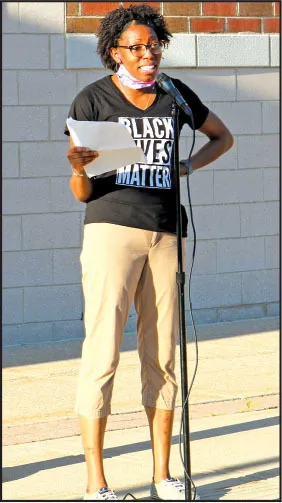
As educators across the state joined in demonstrations this spring calling for racial justice after the brutal killing of George Floyd by police officers, a Black teacher in Milton found herself threatened with discipline for addressing the role of race in the slaying of Ahmaud Arbery, a 25-year-old Georgia man.
What transpired ended up drawing hundreds of people to a Juneteenth march and rally organized by the Milton Educators Association and community groups.
The episode involving middle school English teacher Zakia Jarrett’s remark attracted widespread media attention to the issue of structural racism in public education.
Arbery was shot to death while jogging not far from his home, and his killing has led to charges against three white men who were allegedly involved in pursuing and assaulting him before his death. Jarrett was placed on leave after a remark she made about racism was disseminated by a parent in a short video clip showing part of a remote classroom lesson.
The leave was quickly rescinded by the district after officials were confronted by the MEA, but the handling of the matter was seen as clumsy and damaging — and it took weeks for the district to craft an apology and conclude an investigation into the source of the complaint against Jarrett.
Educators and many other people in the community concluded that the incident — in which an unauthorized and prohibited recording of a small portion of Jarrett’s lesson was used against her — amounted to another example of structural racism.
Leading up to the Milton rally, several local associations and the MTA had issued strong statements in support of Black and brown educators and students that condemned the injustice of the killing of Floyd — who died at the hands of police officers in Minneapolis — as an example of deep-seated structural racism.
MTA President Merrie Najimy said that for the past several years the union has been actively engaged in antiracism, from demonstrating against the negative impact that charter schools have on communities of color to calling out the implicit and explicit racism inherent in high-stakes standardized tests such as the MCAS.
"We need to talk about how racism manifests itself and gets reproduced in public education," Najimy said, noting that antiracism extends well beyond the fight for equitable education funding and the need to hire more educators of color. The work of antiracism must dig into students’ day-to-day lessons, she and other advocates believe.
"If you start talking about Black lives at the moment of slavery, you have humiliated and disempowered Black youth," Najimy said.
Local actions in support of racial justice in education have created spaces for students to speak out alongside educators. Several events have included students expressing their frustration with feeling they need to conform to an identity that is not true to themselves and a curriculum in their school that lacks cultural diversity.
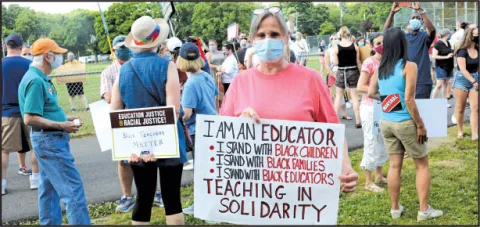
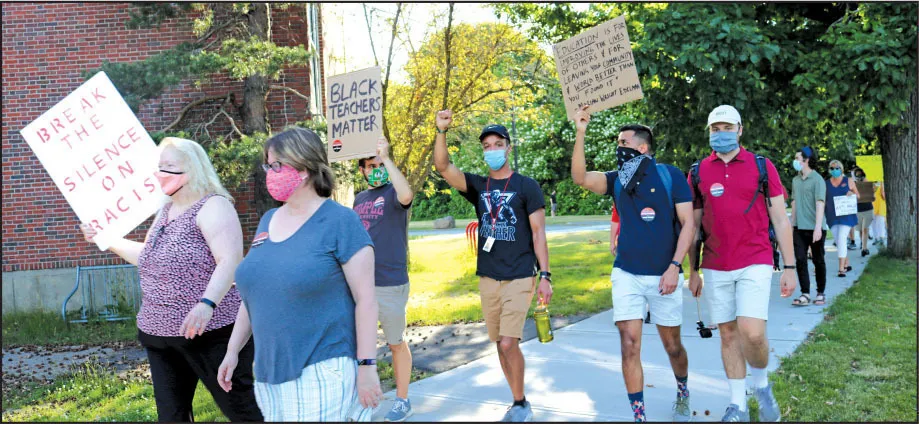
The critiques have been echoed by educators. At a recent rally in Brookline that drew hundreds of people demanding the funding necessary to avert layoffs and to diversify the teaching ranks, physics teacher Graciela Mohamedi said she spent years going by "Grace" before demanding that others learn how to pronounce her name correctly.
The Brookline chapter of ALANA — African, Latinx, Asian and Native American educators — blasted the district administration for slashing its budget and sending out layoff notices. The move substantially affected educators of color, who were more recently hired and therefore less likely to have attained Professional Teacher Status.
The ALANA group took the lead in organizing the June 15 rally in Brookline and assembled a program that featured only speakers of color. From kindergarten educators to music teachers, they made the point that students need to see themselves reflected in their educators. That is not the case now in most communities with diverse populations.
Brookline Educators Union member and ALANA activist Jason Moran told reporters that the district undermined all of the work that had been taking place to diversify the staff. The layoff notices paved the way for affected educators to take jobs elsewhere, even before Brookline rescinded some of the pink slips.
As Jarrett’s story spread nationally, her passion and dedication became as compelling to others as the situation she found herself in. Comedian Sarah Silverman, known for her biting social satire, sent out a tweet expressing her admiration for Jarrett’s work in introducing middle school students to important Black writers and getting them to grapple with difficult topics.
At the Milton rally on June 19, Jarrett read a letter she had received from one of her students. In it, a young girl thanks her teacher for inspiring her to think more deeply about how to make things better in her community.
"That letter showed me that our students are always watching," Jarrett said. "If you speak up about injustice, they will speak up about injustice. If you remain silent, they will remain silent."