A veteran of countless political actions, Deb Gesualdo, president of the Malden Education Association, was readying herself for the legwork needed to bring a request for a resolution supporting the Fair Share Amendment to her city’s School Committee.
Usually this involves finding a friendly member of the committee who could sponsor a resolution — or asking the mayor to do so. Before she had time to think it through, however, a School Committee member beat her to the agenda.
Keith Bernard, a newly elected member, sponsored a resolution to support the amendment, and the committee went on to approve it in early April, albeit on a divided vote.
Gesualdo took Bernard’s initiative as a sign that information about the Fair Share Amendment is filtering through Massachusetts communities.
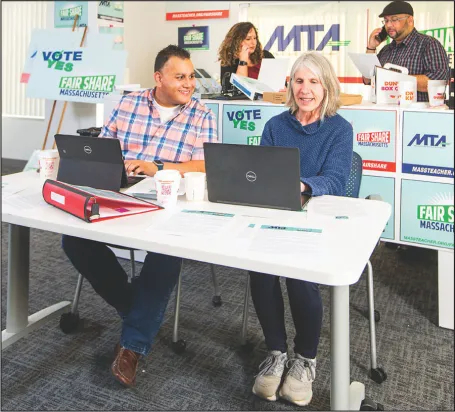
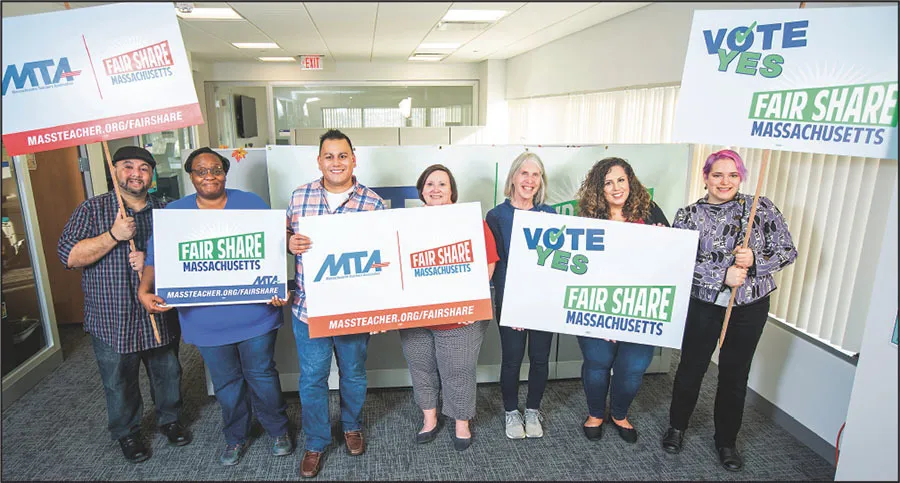
Making sure that happens is part of the mission of the growing number of MTA members who are volunteering for the campaign. They are spreading the word and building support for the ballot measure through individual and small-group interactions.
"Someone on the School Committee put it forward before I could even do it. That has never happened before," said Gesualdo, who is also an MTA Senate District Coordinator. "I was getting ready to do the legwork, and I looked at the agenda and thought, ‘Gosh! There’s a resolution on there!’"
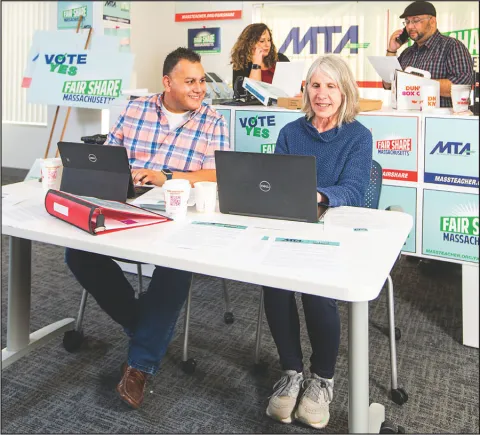
The Fair Share Amendment will go before voters statewide on Nov. 8. It would amend the state Constitution to add 4 percentage points — 4 cents on the dollar — to the tax on the portion of annual income above $1 million. The Commonwealth now has a flat tax rate for all incomes of 5 percent.
If approved, the ballot measure would raise about $2 billion each year — needed funds that would be directed to public education and transportation.
In recent months, the MTA’s grassroots campaign to support the amendment’s passage has kicked into high gear. The current emphasis is on conversations among members, whether through phone calls or talks with groups.
As of the end of April, 24 phone banks had been organized featuring MTA members and more than 54,000 calls to members had been placed. Roughly aligning with several public polls, 82 percent of the people contacted so far have said they plan to vote "yes," according to the campaign.
Meanwhile, physical and digital pledge cards are being distributed and promoted. The straightforward cards are available in both Spanish and English and include essential information about the amendment.
Just before MTA Today went to press, door-todoor canvassing of registered voters was getting up and running in several communities, including Pittsfield and Springfield. Boston, New Bedford and Lynn all were scheduled to have canvasses launched on April 30, according to Raise Up Massachusetts, the statewide coalition of union, faith-based and community organizations that is working to pass the amendment.
Bernard, who joined the Malden School Committee in January, is an active member of Progressive Mass, which, like the MTA, is a partner in the coalition. As is true of other supporters, Bernard sees a clear need for more education funding in the state.
In his conversations about the amendment, he has explained that the $1 million income threshold, broken into a weekly amount, is about $20,000. That helps people see who will be affected and who will not. The additional funds will make a real impact, Bernard said. "Typically, we’ve underfunded our school systems," Bernard said in an interview. "I wanted to make sure every kid who’s going to our school systems had every investment."
The Malden School Committee endorsement is among at least 18 approved by city councils or school committees in Massachusetts communities so far, from Pittsfield in the Berkshires to Lynn on the North Shore. The coalition is encouraging community leaders to support either municipal resolutions or endorsements. Volunteers are also asked to submit letters to newspaper editors and post about their support for the amendment on social media.
The MTA’s efforts — like those of allied organizations and the broader campaign — will intensify through the spring and beyond. As the weather warms, MTA Summer Member Organizers will start to reach out to fellow union members — including Education Support Professionals, teachers, higher education faculty members and other staff, from prekindergarten through college — to help pass the ballot measure.
Ismael Colón, a Spanish teacher at a Waltham middle school, is among the union members who are distributing the campaign’s physical pledge cards. The simple act of handing someone a card gives him an opportunity to briefly explain what the Fair Share Amendment is and what it would do for Massachusetts students and communities.
"It’s just telling them a little and getting them engaged to take time to read it," said Colón, who is a building representative at McDevitt Middle School.
In Waltham, he said, he sees evidence of the disparities in educational spending. Like most educators, he has put his own money into his classroom. Colón bought his own projector, for example.
"In our school, we can see the level of economic difference," he said. "Every single classroom should be comfortable for the students. Everything should work in the classrooms. And we’re not seeing that."
Colón is collecting the cards he’s distributing — and so far, the response has been positive. He feels encouraged about the amendment and what it could mean.
"We could do a whole lot better for our students, for our families — for the working-class families who may not have another car, and they rely on public transportation," Colón said.
The grassroots organizing, and having union members talking to fellow union members, is vital to the success of the campaign, noted MTA President Merrie Najimy, who spoke about the effort at the 2022 MTA Education Support Professionals Conference in early April.
"Our schools are not broken. Our schools are underfunded," she said. "Our colleges and universities are not broken. Our colleges and universities are underfunded — in many ways worse than preK-12 schools."
Ensuring member-to-member contact is the way to win the campaign for the amendment, according to several educators who are engaged in the effort.
"I sneak it into conversations whenever I can," said Sara Dion, a teacher who is a member of the Medford Teachers Association. She’s also an elected member of the Somerville School Committee. Dion has an opportunity to bring the amendment up in that sphere, sometimes in discussions of the budget now under development, and is doing that as well.
The responses have generally been positive, said Dion, who is optimistic that the Fair Share Amendment will be approved by Massachusetts voters in the fall.
"I don’t know anyone who has an income over $1 million a year," she remarked. "It seems like such a basic thing. There’s way more of us."
Sheila Hanley, an educator who retired after a career in the Randolph and Newton public schools, is among the MTA members making calls to fellow members and having informal conversations about the amendment.
The argument about what’s fair — and fair taxation — is well understood among educators, Hanley said. "With just a few exceptions, people are saying, ‘Of course I can support that. That’s fair,’" said Hanley, who, like Gesualdo, is an MTA Senate District Coordinator.
Hanley enjoys talking to other educators and has found that the conversations make a difference.
"As educators/organizers we know the value of one-to-one conversations with our members," Hanley said. "This campaign success will be in conversations neighbor to neighbor and in conversations with all of the groups we are connected to in our community."
Candace Shivers, president of the Mount Wachusett chapter of the Massachusetts Community College Council, has been talking with her colleagues on campus for months about the upcoming election. Shivers, who is an associate professor of sociology, is spreading the message through both her personal and union contacts.
"What I’ve tried to do is let everyone know what’s happening, why it’s important. Stay involved," she said.
Many educators may not feel the intensity of the upcoming election yet, but Shivers said that as it approaches, the campaign will make sure they’re aware of the ballot measure and what that dedicated funding could mean.
Her campus, for example, has funded just one counselor for mental health purposes even amid the COVID-19 pandemic. Awareness of the amendment seems to be growing. Shivers recently spotted an ad in her Facebook feed for the first time.
"Once we get a little bit closer, people are going to start seeing the messaging," she said.
Gesualdo, who has participated in several MTA campaigns — including the "No on 2" effort in 2016 to stop the unfettered expansion of privately run charter schools — is confident that the network of educators covering their communities will sway the outcome.
Like other activists, she said, she’s working the message about the Fair Share Amendment into daily conversations — "not just for me, but for building reps, bargaining team members and Executive Board members in Malden."
"Basically, every member we talk to, the Fair Share Amendment is a part of our conversations," Gesualdo added. "We know what wins a campaign. You can sink all the money in the world into commercials, but it’s the grassroots connections."
For more information on the campaign, please go to massteacher.org/fairshare and regularly visit the MTA’s social media pages on Facebook, Twitter and Instagram.