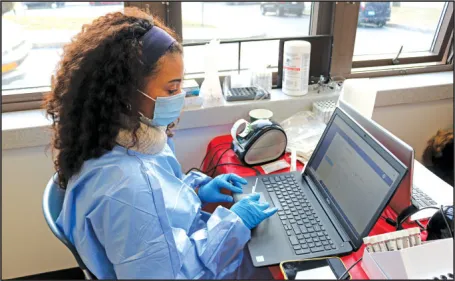
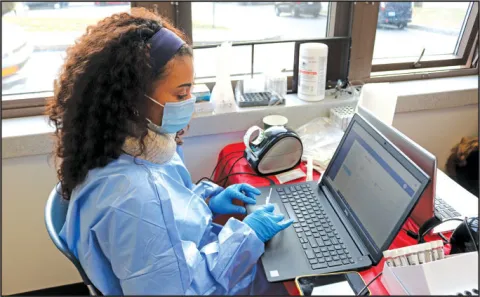
Anew COVID-19 testing program that MTA members have been advocating for since July is finally being put in place, but members are advised to not let their guard down. Testing needs to be coupled with a continuation of safe practices and vaccine injections for staff — now delayed — before the time will be right to significantly increase in-person learning.
"Our insistence on masks, handwashing, distancing and — when needed — remote learning has kept schools from becoming superspreader sites," said MTA President Merrie Najimy. "Nationally, more than 440,000 Americans have died from COVID-19 and many more are suffering from the long-term effects of the disease. This is no time to take down the guardrails that have kept us from going over the cliff."
Organizing and bargaining with guidance developed by the MTA Environmental Health and Safety Committee continue to be critically important.
While agreements have been reached collegially with some school administrations, members in other locals are still having to protest through standouts and other means.
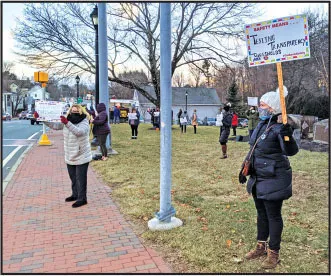
One example is in Middleton, where health concerns motivated a normally quiet local to take action. In January, Middleton Educators’ Association members stood outside their schools during non-work hours to protest the resumption of in-person learning after the holidays even though the community has had one of the highest coronavirus transmission rates in the state. Members were also upset about the district’s refusal to bargain over key safety protocols.
"We’re asking for more transparency and for having honest conversations about what’s best," said Carrie Windmiller, co-president of the MEA. "We need them to step it up a notch with testing, with protocols for when we go remote, with a vaccine plan and with a quarantine plan."
One of the MEA’s demands may soon be met as the new COVID-19 testing program is rolled out across the state. Under a program unveiled in January, the state will fund weekly pooled testing of all students and staff through March 28 in districts that have applied to take part. After that, districts that want to continue the program must pick up the costs using federal COVID-19 relief funds. More than 200 districts have expressed interest in the program to the state, but a smaller number had completed the full application process by the end of January.
"Testing is so important for understanding where the virus is and taking steps to stop it from spreading," said Scott Fulmer, chair of the EH&S Committee.
Several school districts, including Watertown and Medford, have already implemented testing on their own. MTA Today visited Watertown on Jan. 21 to see how it works.
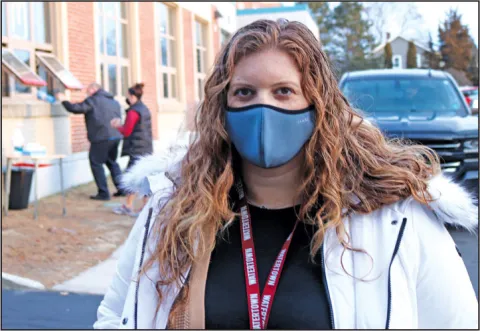
In the gray light of early morning, cars rolled into the parking lot at Watertown Middle School and pulled up to two windows at the front of the building. Above the windows, someone had affixed a giant yellow "M" since the scene looked like a McDonald’s drive-through.
One by one, staff members drove up to the windows, got out of their cars, swabbed their own nostrils and deposited their swabs into a tube handled by the two school nurses running the program, Michelle Laracy and Bianca Jones. The whole process took a matter of seconds.
"I won’t lie to you — it was a lot of work to set it up," Laracy said. However, now that they have worked out the logistics, she said, it is busy but manageable — and well worth the effort.
Laracy and Jones typically test 150 to 170 staff members an hour, or more than 300 a week, using a PCR — polymerase chain reaction — system. In Watertown, each staff member receives individual results in about 24 hours.
The nurses also developed protocols for pooled testing of students, which began in late October. In the elementary schools, a school nurse comes to each classroom with a cart and tests all of the students in less than five minutes. Middle school students are tested during their mask breaks, and high school students line up at stations during their lunch hour or during gym class.
In addition to doing the tests, the nurses have to take care of logistics, such as making sure the tubes are labeled properly and shipped to the right places, and that supplies are ordered. Learning the software programs to keep track of everything also took work.
Staff members receive their own results. Where students are concerned, when a pooled result comes back positive, Laracy and Jones call everyone in the group and have them quarantine until they return — usually the next day — for a second test.
In Watertown, the second test is also a PCR test that takes about 24 hours to process, so everyone retested must remain in a brief quarantine until the results are received.
As of Jan. 25, 600 pooled tests had been conducted, and nine had come back positive. Thirteen staff members also tested positive.
Although the district’s positivity rate has been well under 1 percent, the information has been invaluable for identifying and quarantining asymptomatic students and staff.
"There has been no spread in schools," said Laracy.
The process will be even faster for districts taking part in the new state program. They will have access to the Abbott BinaxNOW antigen test for the second test. Results are available in about 15 minutes, which means fewer people having to quarantine while awaiting word. Staff tests also will be pooled rather than done individually.
Although the district’s positivity rate has been well under 1 percent, the information has been invaluable for identifying and quarantining asymptomatic students and staff.
On the day MTA Today visited Watertown, three middle school students demonstrated the process. Middle and high school students can swab their own noses, while adults swab the noses of elementary school students. Sixth-grader Declan Chapron matter of factly blew his nose, disinfected his hands, and then quickly swabbed each nostril before depositing the swab in a glass tube.
Declan said that the testing program makes it easier to visit family and enables him to learn in school more safely.
"If they didn’t do testing and someone in school didn’t know they had it, then maybe they’d take their mask off to get a drink of water and it could spread the germs," he said. "It’s comforting that there’s testing."
That sense of comfort is widespread. Watertown Superintendent Dede Galdston said in a stateproduced webinar that only 14 percent of the parents and staff surveyed said they were comfortable with in-person learning without testing, but that number rose to 78 percent with testing.
Galdston and the superintendents from Medford and Salem had advice for other districts planning to start a program.
Have a strong team in place. That could include school nurses, Education Support Professionals and parents. Parent-teacher organizations and parent volunteers can be enlisted to help encourage caregivers to sign their children up. Salem made testing mandatory for students participating in sports.
Universal staff participation. The unions in these districts played a key role in getting members on board and negotiated protocols, as well as stipends for those who have to administer the testing program.
Do not commingle your pools. Keep student and staff tests within their cohorts as much as possible, since mixing pools could mean quarantining many people unnecessarily.
Make sure parent consent forms are translated into languages other than English and reach out to communities of color. Frequent communication to parents is necessary, especially to marginalized communities. In Medford, for example, Superintendent Dr. Marice Edouard-Vincent produced a public service announcement of herself being tested to encourage communities of color to participate.
Additional staff may have to be brought on to do the testing, and/or existing staff may have to be paid stipends to work additional hours. In Watertown, school nurses receive stipends for their extra work on testing. Some districts may have to hire staff or contract with a testing service. The state program is designed to make those services available.
Set up student testing in a way that is least disruptive to education. In Watertown, testing from a cart works well. In Medford, testing is also fast as classes of students are brought to a testing station within the schools.
The best advocates for the program are staff and students who have participated already. After depositing her swab in Watertown, Amy Hantson said that word-of-mouth among students had resulted in nearly all of her first-grade class participating. Students just needed to hear from other students that swabbing doesn’t hurt.
The program has given her greater peace of mind. "I have a young son and elderly parents," Hantson said. "Coming back to work at first was a bit nerve-wracking for me. I feel better knowing the school is taking an active role in testing as many people as possible. It makes me feel a little safer coming to school at this time."