We are facing the worst public education crisis in living memory. It didn’t have to be this bad. A mismanaged and chaotic response to the pandemic at the national level has been made worse by delayed and vague guidance from the state. Coupled with decades of disinvestment in public education, particularly in low-income communities and communities of color, these conditions mean that we trail the world in being able to reopen schools safely.
"This is our moment of truth as union members and as educators," said MTA President Merrie Najimy. "We will continue to be hit with crises if we as a society don’t address the underlying issues that have made the U.S. a world leader — a leader in disparities, division, dysfunction and death."
Among all of the bad options, the MTA is backing the least harmful one — a remote start to the school year for everyone and a gradual return to in-person instruction only when health and safety conditions have been met. Although educators want nothing more than to be back in school with their students, safety has to be the priority.
On Aug. 8, the MTA Board of Directors adopted a motion spelling out what "safe" means: Indoor air quality in schools must meet appropriate standards; free, rapid and reliable COVID-19 testing and contact tracing must be made available to students and staff; and appropriate public health benchmarks must be met.
These standards are needed to protect the wider community as well as students and staff.
Orman Beckles, the parent of a student at the Linden School in Malden, said at a rally in his community on July 30 that he worries about what will happen if buildings reopen too early.
"I’m a Black male," Beckles said. "I have diabetes and I have high blood pressure. I love my son.
"They talk about the psychological effects if he stays home," he continued. "What about the psychological effect if he brings something home and it kills his father? Kills his mother? Kills his grandmother, who is 89 years old? And that’s a real possibility. Maybe he doesn’t get sick, but if he kills all of us, how is that going to affect him for the rest of his life?"
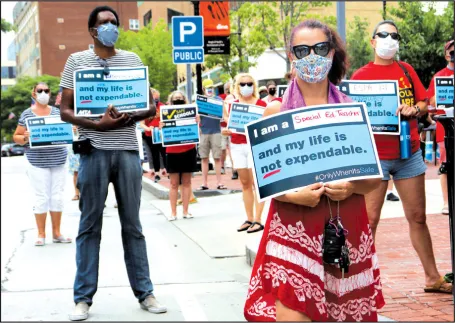
For many MTA members, this is the summer break that wasn’t. Thousands spent their "vacation" taking part in local and statewide meetings, holding signs saying their lives are "not expendable," sending messages to elected leaders, bargaining, organizing and taking part in professional development.
Member activism led to a big victory on July 27. Education Commissioner Jeffrey Riley agreed to delay the return of students by 10 days, giving educators a chance to collaborate and redesign teaching and learning.
The MTA is encouraging members to include current events in their curricula, including the coronavirus pandemic itself and racial justice issues propelled by the killing of George Floyd in Minneapolis and others across the nation. ALANA Educators — an MTA network of African, Latinx, Asian and Native American educators — made this point in a statement released this summer. "Surprisingly, COVID-19 has given us a chance to reimagine what education looks like, as well as how and what we teach," the statement said.
MTA field staff and members have been working nonstop since schools closed in the spring. In late June, the Department of Elementary and Secondary Education told districts to create three plans — full-time in-person, hybrid and full-time remote — while pushing them to open with the in-person model. Governor Charlie Baker asked districts not to commit to a final plan until Aug. 14, not long before the start of the new school year.
The stress has been tremendous on members. They have gone all summer not knowing what their jobs will look like, what their own children’s schedules will be, and whether they and their families will be protected from infection.
Activities are ongoing, with plans underway for larger actions in the days ahead. Here are just a few:
- The Malden Education Association organized two socially distanced rallies in front of DESE’s headquarters, the second on July 30. Deb Gesualdo, president of the MEA, said at that rally, "We will not allow our students, educators, families and communities to be put at risk of getting sick and dying from the premature return to in-person learning." Similar rallies have been held in Springfield, Pittsfield and elsewhere.
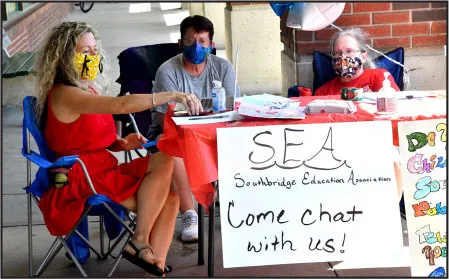
- In Southbridge, a school district in receivership, local President Jocelyn Tallis and other MTA Summer Member Organizers set up a table outside the Big Bunny Market to talk to parents and hear their concerns. One of the SMOs helped translate for parents who don’t speak English. The district receiver said he was so impressed that he planned to hire more school staff to go door to door.
- The Amherst-Pelham Education Association was one of the first locals to come out strongly for a remote opening. A July 7 letter to the School Committee stated, "We request that you not allow any excuse to justify risks that may threaten the health or life of even one person, as together, we fight COVID-19. Let us continue to live, to teach, and to learn in the safest possible way, remotely." Many more locals have now sent similar messages.
- Watertown Educators Association member surveys showed that support for in-person instruction dropped dramatically between July 16, when about half favored being fully back or the hybrid model, and July 27, when more than 80 percent supported either full-time remote learning or starting remotely. After the second survey, WEA members flooded the School Committee with emails and phone calls. On Aug. 6, the committee voted to start the school year remotely. WEA President Deb King said, "Without the collective action of our members, we would be starting school in a hybrid model rather than a remote model."
- Several locals have joined together in regional Massachusetts Educator Action Networks to issue statements and support one another. These included WeMEAN in Western Massachusetts, NoBEAN near and north of Boston, and one comprising 13 locals on the Cape and islands. The latter group released a statement in July that called for adequate funding. "Returning to learning requires more money and more staff: smaller classes, more bus capacity to enable physical distancing, more nurses and counselors and Education Support Professionals to address student needs, and an unwavering commitment to using the appropriate PPE and following health and safety protocols," it said.
- Thousands of members took part in professional development, including Miriam Kranz, a Southbridge theater teacher. Kranz said her activities in the spring and summer included building an interactive website, "upping my tech game" and participating in a lot of self-funded professional development. Understanding that struggling districts such as Southbridge need more than the three R’s to keep students engaged in remote learning, she has been exploring creative alternatives to live theater, such as filmmaking and podcast production. Many other MTA members spent time this summer learning new skills for educating during a pandemic.
The MTA’s positions have been informed by numerous meetings with local presidents and other members, including a Zoom teleconference on July 29 that drew 7,500 members — the largest meeting in the MTA’s 175-year history.
During these meetings, participants responded to instant polls, asked questions and shared ideas. Answers are being provided through guidance and legal advice, including a memo on rights afforded to members who are at high risk from the virus.
The MTA has been amplifying the voices of members extensively through the media and social media. Najimy has been interviewed by nearly every major newspaper, television station and news radio program in the state, many of them several times. She also has been featured in national media such as Matter of Fact with Soledad O’Brien.
The message has been consistent. Schools must be safe. High-need students should be prioritized. Adequate funding is necessary. Educators must play the central role in making and implementing policies, including curriculum that intentionally fights structural racism. Now more than ever, educators’ unions are needed to make all of this happen.
Graciela Mohamedi, a Brookline Educators Union member and the ethnic minority representative on the MTA Executive Committee, said on one of the caucus calls, "What’s going on right now around reopening is frightening, but this is why we have a union. There are more of us than there are of them. They can’t drown us all out.We need to stand together. That’s how we show our power."

Get Instant Access with a Digital Subscription!
Visit our website today to choose from more than 30 favorites with instant access:
www.MTAMagazineService.com/digital-magazines/instant-access-magazines
- Choose from titles such as Popular Mechanics, Good Housekeeping, Runner’s World and many more.
- Order today and receive the first issue instantly.