The shock of what happened on Jan. 6 " will linger — and it should," MTA President Merrie Najimy wrote to members two days after the insurrection in Washington, D.C.
"The storming of the Capitol by a violent mob spurred on by President Donald Trump is the disastrous climax of an orchestrated effort to dismantle democracy via denigrating public institutions, undermining the common good, and stoking the most despicable white supremacist flames of racism and hate," she continued. "What unfolded in the waning days of the Trump administration had nothing to do with differing political points of view. Instead, we saw an assault on our democracy by extremists who do not share the values we aspire to instill in our students."
People all over the country — and around the world — were left speechless, but educators pivoted immediately to their gravest concern: What would the rampage mean for their students and students’ families? And how could they put the events of that day into context?
MTA Today talked to three educators about how they helped their school and college communities process what they had witnessed.
Stephanie Hunt
Hunt is the program coordinator for Brookline High School’s African American and Latino Scholars Program. What follows is a shortened version of a letter she sent to colleagues the day after the insurrection.
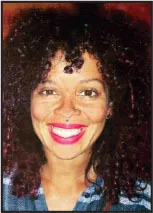
Our Senior Scholars are struggling right now. Deeply. They are shaken by what they witnessed take place in the Capitol yesterday and are having real difficulty making sense of it and seeing a way through it. Many of these students participated in social justice demonstrations over the summer and cannot understand the difference between the responses to them and to those who rioted in D.C. yesterday.
I know we are all struggling with this. But it is important to note that our students of color are struggling in different ways. More than one student cried during seminar today. One said, amongst tears, "How can I focus on my problem set when my very existence feels under attack?" Others agreed.
I know that many teachers took time out of today’s class to have conversations (thank you!), but I ask that we take it a step further and truly give students, especially our students of color, the time and space to take care of themselves without fear of late credit/penalty.
Amel Ahmed
Ahmed is an associate professor in the Department of Political Science at UMass Amherst.
I always encourage my students to think about events comparatively — across both political and historical contexts. I think this is especially important for understanding the events of Jan. 6. Discussions of democracy backsliding in the United States over the past several years have often looked to examples in other countries, such as Hungary, Turkey or Venezuela.
These are all places where a democratically elected leader corroded democratic institutions in the quest for executive aggrandizement. These examples, while instructive, are limited in the U.S. context for many reasons, the most important of which is that the political class in the United States is deeply invested in elections as the means of gaining power. This does not mean that democratic backsliding cannot happen, but that it will probably look different.
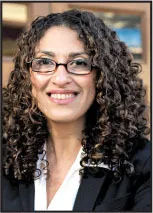
Historically, the way that democracy has expanded and contracted in the United States has been through the franchise and through voting rights. And this is likely what we are going to see moving forward: universal condemnation of violence, but a fierce fight over voting rights and specifically the restoration of the Voting Rights Act.
Saul Ramos
Ramos is a one-to-one paraeducator and Braillist who is in his 22nd year of working for the Worcester Public Schools. He currently works at the Roosevelt Elementary School.
Ramos was astonished at the scenes of brutality and the blatant racism on display at the Capitol. "There were zip ties. Was this going to turn into a hostage situation? And there was a noose set up outside the Capitol. That by itself it such a symbol of hate."
And yet, Ramos said, some elected officials "didn’t get this until they themselves felt endangered — until they were in the middle of it."
"We’ve gone through many scary moments recently in our history in the United States, but this was a real eye-opener," Ramos said.
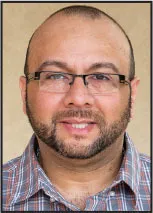
The next day, before having the students begin their day remotely, Ramos said he and the staff members he works with directly — teachers, ESPs and specialists — decided that they wouldn’t bring up the riot in classes because "these students are very young."
If a child asked directly, he or she would be brought to a breakout room and the parents would be invited to join the discussion. Middle and high school educators were prepared to address the incident with their students more directly.
Ramos said the event is an important reminder that students, no matter how young or old, are always watching.
"To me, that’s the important thing," he said. "The kids are always watching. They learn from us. They may not talk about it, but we always need to set a good example for them."