Photographs by
The past several months have seen increasing momentum for the Thrive Act and the MTA’s ballot initiative to end the graduation requirement tied to MCAS. Scores of educators, students, parents and elected officials are speaking out against the high-stakes nature of the MCAS exam and the harm the graduation test does to our communities and youth.
What follows is a sampling of just a few of these diverse voices, including some of the first registered voters who signed the ballot initiative and people who spoke out at the Oct. 4 hearing on the Thrive Act at the State House.
SHELLEY SCRUGGS
Parent of a Minuteman Technical High School student
"My son and countless other students across the Commonwealth, who are creative, competent and enthusiastic hands-on learners, … have been systemically tripped up by the MCAS, which elevates the Ivy League-bound while penalizing students like my son who are just not good at conventional test-taking. And the penalty for young people who do not do well on the MCAS is absurdly high. (Being) denied a high school diploma because of a standardized test score means fewer employment opportunities, a real loss of income and having to explain in a job interview why you don’t have a high school diploma. Enough is enough. It’s time to end the MCAS requirement now."

DEB MCCARTHY
MTA Vice President
"The ballot initiative represents, for me, the aspect of community and activism that has been the focal point of my resistance to our over-focus on a test score. Educators will be able to move toward being less test-centric in our instruction: it’ll be more holistic, authentic and student-facing, and will provide data that is timely, relevant and useful to students, educators and parents. At a time when students are struggling with mental health and we need to meet their social/emotional needs more than ever, we need to rethink our over-focus on a single test score."

CYNTHIA ROY
High school teacher at Bristol-Plymouth Regional Technical School, and among the first signers of the ballot initiative
"I felt inspired to sign the ballot initiative to end the graduation requirement tied to the MCAS because, as a teacher and community organizer, I’ve witnessed firsthand the immense harm it causes. The high-stakes nature of MCAS has not only eradicated joy and creativity from our schools but has also created a stark contrast between education in affluent communities and low-income communities. In affluent areas, where MCAS scores tend to be higher, students enjoy a wellrounded education with ample resources, including arts, recess and music programs. However, in low-income communities with lower MCAS scores, essential programs are often sacrificed for test preparation, perpetuating educational inequality."

LISA GUISBOND
Executive Director, Citizens for Public Schools
"I got involved in fighting the high-stakes nature of the MCAS many years ago. My older child was on an Individualized Education Program, and I was learning all about learning differences and special education at the same time as I was reading that Massachusetts would be tying the MCAS to a graduation requirement. How many decades do we have to wait? The evidence is in: We know who is hurt by the high-stakes nature of the MCAS. It’s past time for us to make a change."

LIZ MIRANDA
State Senator, a co-sponsor of the Thrive Act
"As a first-generation, Cape Verdean-American student, whose parents immigrated to Boston with nothing but their hope and working hands, I came from a mixed-status family. My father and brother were both deported in 1998 as I was beginning at Wellesley College. As a Boston Public Schools graduate … it was evident to me that the curricula was not designed for the ways in which I learned, nor many of my peers who came from diverse backgrounds. This is the moment to create historical change and ensure that young people in our community, and every one of the 351 cities and towns, can leap forward from graduating to accessing higher education opportunities."
MAX PAGE, MTA President
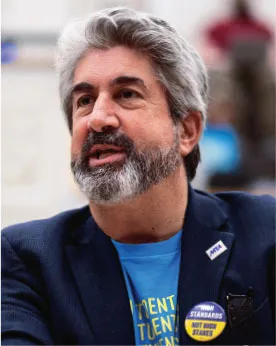
"We are a union that is committed to fixing a key part of what is wrong in public schools, that is this over-reliance on high-stakes testing. What students will be judged on is successfully passing the curriculum that shows they have mastered our state standards. We know that the evaluation by educators, who do this work on a daily basis, who educate our children, is the best reflection of how students have done in their coursework."