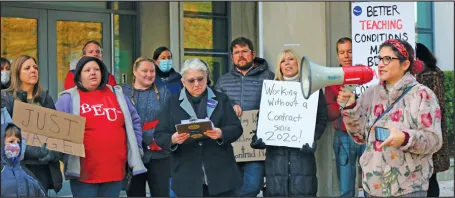
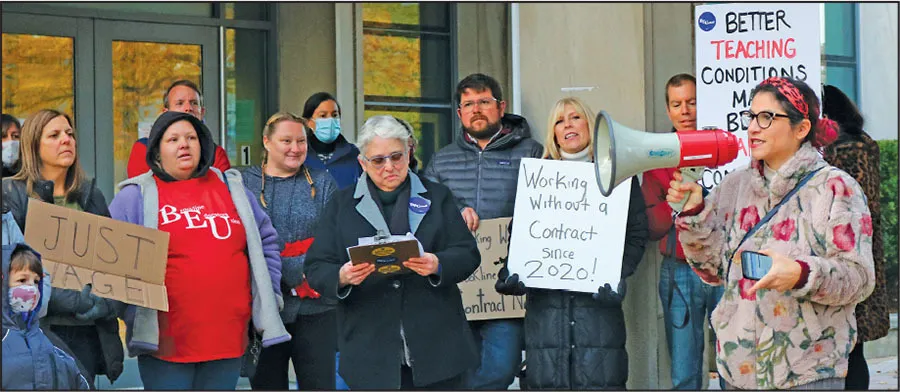
Throughout the COVID-19 pandemic, educators heard how valued they are — and how essential they are to the wellbeing of their communities. Yet as locals move past bargaining related directly to the public health crisis and either resume or restart regular contract negotiations, many are hearing a colder message.
"People are feeling like they got a lot of lip service, but there’s no backing that up with salaries that people deserve," said Deanna Semple, president of the Wareham Education Association, which has been engaged in a fight to win better pay for Education Support Professionals.
In recent months, locals in communities including Belmont, Cambridge, Brookline and Burlington have been holding actions to win community support and put pressure on school committees. It has been common to see crowds of union members at standouts and school committee meetings, displaying signs and handing out informational flyers to parents.
"The number of members showing up to School Committee meetings and standouts is way up," Semple said. "There are paraprofessionals I’ve never met coming up to me for flyers and signs. There’s a lot of fight in them."
Semple’s remarks echo the rallying cry that has become common at MTA gatherings over the past few years: "When we fight, we win."
The hard work of democratizing bargaining and creating regional collaboration is behind the uptick in member activism, according to MTA President Merrie Najimy.
"When we engage more members in bargaining, they experience and witness firsthand the disrespect they are being treated with at the bargaining table," Najimy said. "That has engendered righteous indignation and a willingness for more union members to act up. And when they talk about standing up for themselves, they know that they are also standing up for their students."
Part of the anger that MTA members are demonstrating comes from their awareness that Massachusetts currently has resources from better-than-expected state revenues and from federal coronavirus-related stimulus funding, some of which is specifically intended for public education. Many locals believed that districts finally had the opportunity to improve pay for ESPs as well as address staffing issues and other school needs.
But many local unions report hearing a familiar excuse: "We have no money for that."
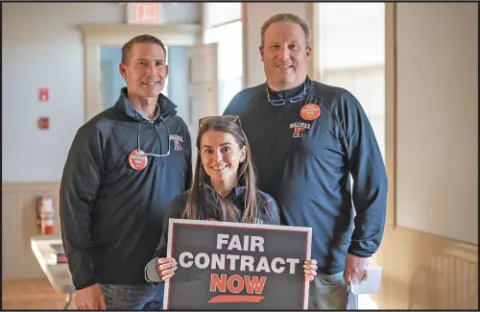
The Halifax Teachers Association is among the locals feeling that sting.
HTA members poured into a School Committee meeting in April following a successful standout at the town center. Educators shared their stories and perspectives about cost-of-living expenses, accelerating inflation, higher health insurance premiums, and having to work several jobs to make ends meet.
When federal pandemic relief funds went into state, city and town coffers, HTA educators thought it might mean there was hope for their needs to be addressed.
"As unprecedented stimulus money was approved for towns and schools, we were again optimistic," teacher Steve Ruisi told the Halifax School Committee in April. "We argued that you have a once-in-a-lifetime amount of federal money to help build your budget. Please invest in us."
But the School Committee has rebuffed the HTA’s wage proposals.
HTA members also lamented Halifax’s decision in late 2021 to provide stipends to all town employees except educators. "We were crushed, shocked, and left disrespected," said Ruisi. "Invest in your teachers. The town has the money. Stay at the table with us and let’s continue to work together on a fair three-year contract."
Najimy traces current attitudes and approaches among union members to the first MTA Bargaining Summit, which was held in 2015. In the years since, more leaders and activists have participated in that summit and shaped a shift toward more transparent bargaining.
It is no coincidence, Najimy said, that Belmont is acting in a bold, unified fashion across its membership, given that the local’s president, John Sullivan, spearheaded efforts to increase member involvement in contract work. State labor officials rejected attempts by the Belmont district to limit the size of the local’s bargaining team, and that inspired many other locals to engage a larger number of members as silent representatives at contract sessions.
Not only are the fights for improved working conditions more visible within local unions but they also are becoming better known among MTA locals. It is now common to see members from different unions showing up to support the actions of colleagues in neighboring districts.
And they talk to each other.
The Brookline Educators Union has been in a heated battle with the town School Committee over a fair contract. The BEU maintains that the committee is undermining the quality of the highly regarded school system by flatly rejecting proposals for wage improvements, racial justice measures and better working conditions to ensure that students’ needs are met.
TTA president’s advice: ‘Listen to your members’
BEU President Jessica Wender-Shubow said that a sense of militancy among members about winning a fair contract is growing as the School Committee grows more dismissive of their concerns.
"We are seeing anti-union attitudes like we never have before," Wender-Shubow said. "They tell us they can’t use federal pandemic relief funds for our contracts because they can’t predict future labor costs. Well, they predict future costs for everything else. Why can’t they predict and plan for school labor costs?"
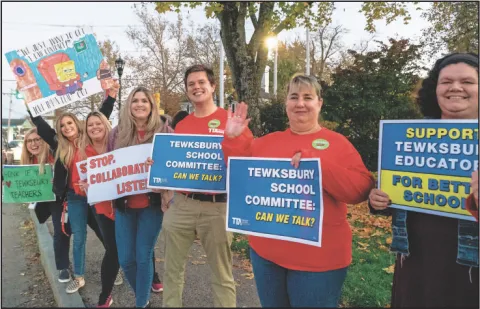
In planning its next steps, the BEU Executive Board met with Tewksbury Teachers Association President Conner Bourgoin.
The TTA escalated actions through a long campaign, adopting work-to-rule actions in November and appearing at School Committee meetings before persuading the district to actively participate in negotiations rather than rely on state mediation to address local issues.
The Tewksbury local notched a victory when members ratified a contract in March. Bourgoin said that communication among members and the community was instrumental in their successful organizing efforts.
"The two keys to winning a fair contract are democracy and transparency," Bourgoin said. "When every important decision you make at the table has been communicated to and approved by your membership, that’s when the members will realize what they are asking for is not anything unreasonable. If your members feel heard and communicated with, that’s when the organizing becomes possible."
In February, TTA educators, alongside other labor allies and Tewksbury residents, held a standout at the high school before addressing the School Committee. In the following days, high school students led a walkout in solidarity with educators.
Getting a pulse of the membership is critical when planning organizing actions, Bourgoin noted.
"Listen to your members," he said. "Officers should never be the ones to demand an action happen if the members are not comfortable with it. A true democratic union is an organized union that is ready to fight."