A first-of-its-kind campaign to unite all of the MTA’s higher ed local associations and chapters in a demand for fair wages is aiming to knock down the belief that so-called salary parameters set by the governor must limit what can be achieved through bargaining.
The campaign — Fair Wages Now! — is underway at community colleges, state universities and UMass campuses, building power and momentum toward the goal of greater investment in workers who make public higher education possible.
“Management sees parameters as the ceiling; we see it as the floor for bargaining. If they can’t do that, then OK, we’ll take the fight to the governor,” said Chris Weeks, a member of the University Staff Association at UMass Amherst.
Members from the various MTA higher ed affiliates have been laying groundwork for this campaign for months. Following a summit at Summer Conference, leaders from individual unions are now garnering support from their members to endorse the campaign, stage local actions, and make plans to attend a Nov. 20 rally at the State House.
The campaign’s goals are ambitious — 30 percent raises across three-year contracts, structured in a way to provide equitable, real-dollar gains for all workers.
“This is winnable if we are all in it together,” Weeks said. It also has helped members like himself see what all workers are up against.
In 2024, a study of wages for workers at Massachusetts public colleges and universities showed how much less our members earned in comparison to their peers in other states; in some cases, the gap is as large as $30,000. The study also noted how wages for faculty and staff have declined since 2016, when adjusted for the rising cost of living.
A regional bargaining council initiated the idea of a statewide campaign to demand greater state investment in public higher education workers. The idea spread and earned the backing of MTA’s Higher Education Leadership Council.
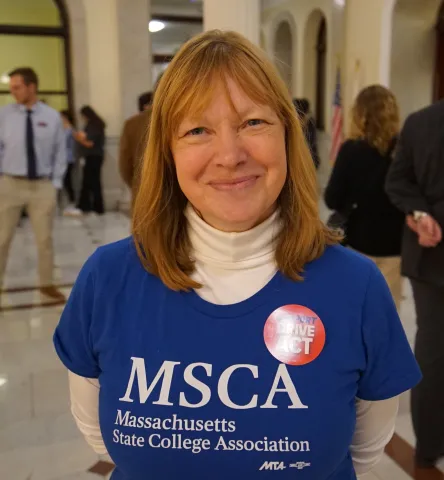
“We were part of the statewide movement that won the Fair Share Amendment and billions of dollars in new investment for public education and transportation,” said Joanna Gonsalves, president of the Massachusetts State College Association, a co-chair of HELC and a professor at Salem State University. “Now we’re building that kind of power again with our higher ed unions to win fair wages for the dedicated faculty and staff who make our public campuses thrive.”
Amanda Achin, a member of the Professional Staff Union at UMass Boston, said the launch of Fair Wages Now! has been energizing, especially seeing workers raising expectations for themselves and tiring of hearing how they cannot be paid what they need to live.
“More and more, people are realizing that campus by campus and local by local, just focusing on those contracts limits us,” she said. “We need to unite and target where the money is. This is an important step forward for MTA higher ed locals.”
It also is a crucial step for protecting the quality of public higher education. Campus workers point out the rising number of job vacancies and corresponding expanding workloads on employees.
In Achin’s case, she felt the real impact of low wages when she was forced to move from her apartment near UMass Boston and could not find affordable housing. She ended up moving out of state, and the commute was becoming so taxing that she nearly left her job, before landing a position that allowed for remote work.
“We deal with a high turnover rate because of the affordability issue,” she said. “A lot of us can’t live where we work, and that commute to Boston really starts to weigh on people.”
Because salary parameters set by the governor apply to all state workers, MTA’s higher ed locals will be welcoming other unions into the campaign.
Achin said that while the fight will not be easy, conditions may favor the unions.
“Progressive candidates across the country are winning races. Those successful campaigns show a demand for public services and for the public good,” she said. “This is an opportunity for us.”
Learn more about the campaign at massteacher.org/fairwagesnow.