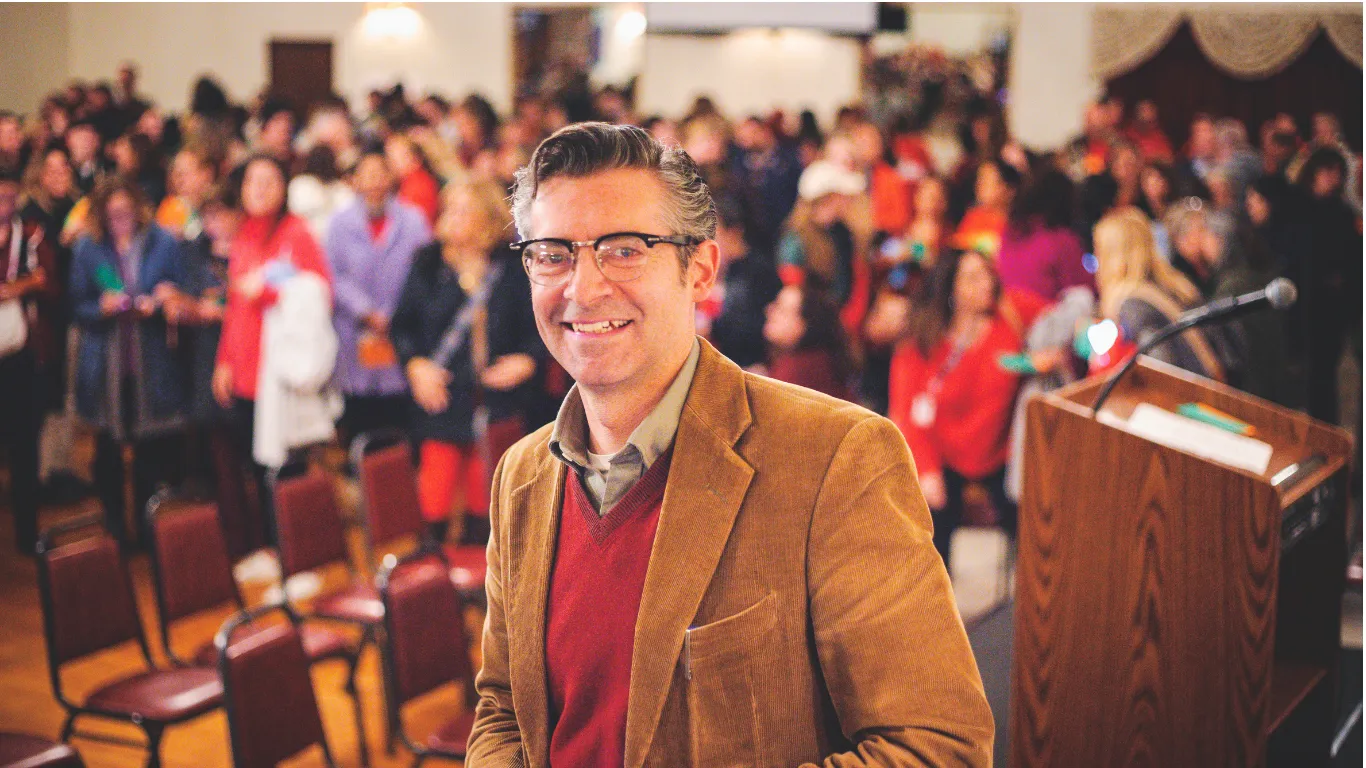
I can not imagine a more satisfying career than teaching history in Andover for the past 25 years. I love coming into my classroom every day, and the work of our union at the local and state level has ensured that I can continue to take such pleasure in my work. I believe that public education is the greatest invention of humanity and the foundation for democracy, progress and economic, racial and gender equality.
Yet, educators know that powerful political and economic forces relentlessly seek to squeeze our craft with austerity and commodify our labor, with corporate ed tech and AI products further consuming our already inadequate budgets. The only force capable of defending public education is not a friendly administrator, or a better-than-average member of the political class — it is our union.
Early in my career I realized that protecting my identity as an educator meant becoming a union activist, an understanding rooted in the working-class values of my parents. My father ran a small tow truck business, and I worked for him through high school to help pay for college, pulling motorists from ditches and cleaning up tractor-trailer rollovers in western New York blizzards. That work taught me the physicality and precariousness of labor and how little the rich, corporations or politicians care about worker safety. My mother, a registered nurse, taught our family about the cruelty of the for-profit health care system, as well as the extraordinary care nurses provide. Because of my parents’ sacrifices, I earned degrees from St. Bonaventure University and Harvard University in history and history of art and architecture before becoming a teacher and proud union member.
When I reflect on my career as an educator, I think not just about the meaningful relationships I have made over the years, but also about our struggles and victories as education workers. In 2020, when Andover educators voted overwhelmingly to refuse to enter school buildings and work outside until the district agreed to negotiate a safe return to work, it was deemed an illegal strike. We were forced back to work, and although we won HVAC improvements, we returned without the certainty of an agreement that prohibited retaliation against our local union leaders — myself included! However, nobody was disciplined or terminated because management was awakened to our power. We learned how the system is not actually an impartial arbiter, and that no one would save us except ourselves. We also learned how to organize for our next strike in 2023 to win better schools for students, members and families.
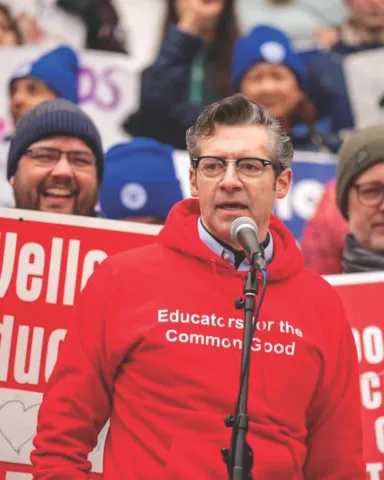
I consider my time as union president in Andover as essential to my contributions as a career public school educator. There is nothing like meeting a former student who has decided to become an educator — except meeting a former student who is an educator on strike! Winning a living wage for ESPs, 12 weeks of paid parental leave, 60 days of humane, paid family medical leave, more recess for dysregulated students, additional planning time for elementary teachers, and built-in union orientation time are highlights of my career. Our strike in Andover was transformational for our members. I could barely recognize people I had worked with for 20 years, as they were rejuvenated by understanding their power as organized workers to remedy injustices and indignities in their workplace.
Deb Gesualdo and I want this possibility for all locals. This moment is filled with fascist aggression, and we may feel overwhelmed with the struggles ahead. But building the union power capable of defeating the threats facing our students and neighbors begins by uniting with our coworkers to fight the authoritarianism in our workplaces. MTA members know when to take up that fight, and we will make sure that you have the MTA resources and organizing support to take militant action when you are ready.
Deb and I have both served as elected MTA leaders — Deb as NEA Director, myself as a member of the MTA Executive Committee, and both of us as Board Directors — as well as local presidents who led transformational contract campaigns. That experience means we are just as ready to guide statewide campaigns to success as we are to support locals in organizing to win historic contracts.
Not only have we created the space for members of our own locals to become union activists, but we have also brought locals together into successful regional bargaining councils. The Merrimack Valley Bargaining Council, which I co-founded, has taken the lead in a formerly docile region to set contract standards and goals across locals. In February, the MVBC led a direct action that resulted in flipping one of the Group Insurance Commissioner’s votes from a “yes” to increasing costs on members to a “no” vote.
Under the leadership of members of Educators for a Democratic Union, MTA has defeated charter school expansion, led the charge for a more just school funding system in the Student Opportunity Act, taxed millionaires to fund public education and infrastructure, and weakened high-stakes MCAS testing. As the democratically nominated EDU candidates, our campaign will continue, expand and deepen those fights for public education and working class families. Our platform, created by delegates from last year’s Annual Meeting and Summer Conference, grounds us within a collective project to build on the campaigns MTA has waged and won over the last six election cycles. Its specific, detailed commitments allow members to hold us accountable once elected.
One of the historical figures I admire the most is Jeannette Rankin, a lifelong advocate for women’s and workers’ rights. Rankin suggested that if you do not have a “philosophy” in times of crisis, you will be incapable of making decisions and essentially surrender that choice to your opponents. Our campaign platform embodies a philosophy of union democracy that has empowered members to win. When elected, that philosophy will continue to hold us accountable to MTA members as they lead the Commonwealth and the nation by democratizing their locals, achieving dignity and autonomy in their workplaces, and winning for the common good.