Published: July 1, 2023
Last Updated: June 24, 2025
We use cookies to offer you a better browsing experience, provide ads, analyze site traffic, and personalize content. If you continue to use this site, you consent to our use of cookies.

FAQ: Proposed Legislation Concerning an Opportunity to Participate in Retirement Plus for Teachers Hired Before July 1, 2001
Answers to frequently asked questions about RetirementPlus legislation compiled by the Massachusetts Teachers Association, the American Federation of Teachers Massachusetts and the Boston Teachers Union.
Share
Overview Questions
What problem does the proposed legislation seek to resolve?
In 2001, when Retirement Plus (R+) was first introduced, many teachers encountered a
confusing enrollment process. Some never received an enrollment form while others were led to believe they were automatically enrolled in R+, only later learning that they were not. The MTA, AFT-MA, and BTU have been organizing to push for members in these situations to have a chance to join R+ and have engaged in an administrative appeals process for individual members over the years but an August 7, 2023 ruling by the Division of Administrative Law Appeals (DALA) has made it clear that legislation is needed to fix this problem.Two bills (H.2932 filed by Representatives Alice Peisch and Rob Consalvo, S.1884 filed by Senator Liz Miranda) are currently under consideration by the Joint Committee on Public Service that would allow teachers hired before July 1, 2001, who did not “elect” to join R+ to have a new opportunity to do so.
What is Retirement Plus (R+)?
Retirement Plus is a program that increases retirement benefits for eligible and participating members who have completed 30 years of service (at least 20 of which are membership service with the MTRS or the Boston Retirement System as a teacher). For members with effective membership dates before April 2, 2012, an additional 2% for each full year of creditable service greater than 24 years is added to your pension benefit, up to a maximum of 80%. The contribution rate for R+ is a flat 11%.
How can I see what being in R+ would mean for my pension?
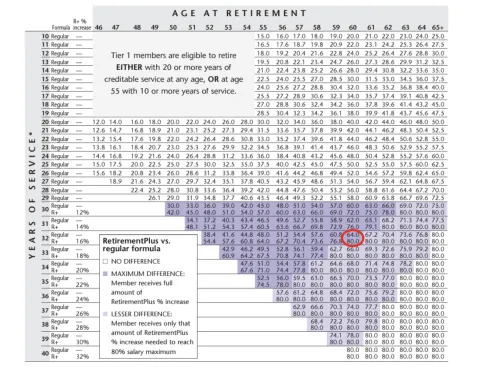
See the MTRS “Retirement Percentage” chart for tier 1 members, which shows a comparison of the percentage of salary average allowed under the regular and R+ formulas, by years of service and age at retirement. At 30 years of service,the R+ enhanced benefit is added for those who participate. As an example, someone who is enrolled in R+ and is 60 years old with 32 years of service if they retired would receive the maximum 80% for their pension while someone who is also 60 years old with 32 years of service but not enrolled in R+ would only receive 64%.
What were the original opt-in requirements for R+ when it was introduced?
In February 2001, when R+ was first introduced, then-current members of the MTRS were mailed an Election Form and given from between January 1, 2001 and July 1, 2001 to affirmatively elect to participate in R+. Members who did not return their election form were not included in R+. However, many members did not receive their forms or did not receive clear information about the importance of the benefit being offered or were led to believe they were already enrolled in R+ when that was not the case. Union legal teams have appealed such cases unfortunately without success and the recent decision by the Division of Administrative Law Appeals (DALA) stated that the MTRS did not violate the law in denying these claims. S.1884 H.2932
What are the specific provisions outlined in these bills?
S.1884 filed by Senator Miranda and H.2932 filed by Rep. Peisch and Consalvo have identical language, it is common for legislators to partner to file versions of the same bill in both the House and Senate. By clicking on the links, you will be able to read the exact text if you wish. Section 4 of these bills states that any member of the MTRS or Boston Retirement System who became a member of the retirement system before July 1, 2001, began contributing to the MTRS or BRS on or before July 1, 2001 and did not provide a written election to enroll in R+ during the or declined to participate will have a new one-time opportunity to elect to participate in R+ if passed. Section 4 also states that a member who elects to participate in R+ will make contributions at the rate of 11% moving forward and shall be required to provide make-up contributions from the date that they established membership in the MTRS or BRS.
Sections 1-3 of the bill address pension issues related to teachers who became employed at the Executive Office of Education or the Department of Elementary and Secondary Education and return to teaching, ensuring that they would not have an interruption of membership or service and would also be eligible for the R+ opportunity. Section 5 of the bill addresses issues related to teachers who retired under R+ and subsequently return to service under the state’s critical shortage law.
Where can I go to check for updates on the progress of these bills?
- MTA Members: MTA R+ Legislation Webpage
-
AFT & BTU Members: AFT R+ Legislation & BTU Political Action
You can also check for the most up-to-date information by keeping an eye on each of the bills’ State House webpages here: S.1884, H.2932. Each page will show a bill history list detailing each step in the legislative process as they move forward.
What is the difference between these bills and the law passed in 2022 that offers an opt-in opportunity for teachers who transferred into the MTRS from another retirement system?
An Act relative to the alternative superannuation retirement benefit program for teachers, was signed into law in August of 2022 and allowed a one-time opportunity to enroll in R+ for teachers who transferred into the MTRS from one the other 103 Massachusetts public retirement systems between July 1, 2001 and June 30, 2022 and therefore missed the original election window and were also not automatically enrolled in R+. These eligible members had a final, one-time opportunity to make their election to participate in R+ between January 1, 2023 and June 30, 2023.
These new bills (S.1884 and H.2932) deal with teachers who were already members of the MTRS and Boston Retirement System when R+ was first introduced and does not address transfers into the systems.
Why is the “9+2” regular contribution rate not the same as the 11% R+ contribution
rate?
If you are not participating in R+, you are contributing at one of the lower contribution rates – most likely the 9% flat rate on your entire salary, with an additional 2% on earnings over $30,000. This rate is called “9+2” or “9 and 2”. Some members are contributing at an “8+2” rate, which is a rate that pre-dates the “9+2” rate. Because the additional 2% withholding is only on a portion of your salary in the “9+2” rate, one’s contribution under this structure wouldn’t be equivalent to the R+ rate. The difference between both contribution rates is $600 annually.
Eligibility
What are the eligibility requirements for the opt-in should these bills pass?
As currently written, though there are slight differences in language, the bills outline the same criteria for eligibility that a member must meet – the eligible teacher:
(a) must be a member of the MTRS or Boston Retirement System who became a member of their retirement system before July 1, 2001;
(b) had to have begun contributing to the MTRS or BRS on or before July 1, 2001; and
(c) did not provide a written election to enroll in R+ or declined to participate during the
original enrollment period of between January 1, 2001 and July 1, 2001.
It is important to remember that changes can be made to any part of a bill during the
legislative process. Please check the bill pages to view the most current language.
Would this be an option for those who are 9% plus 2% as well as 8% plus 2%?
Yes. Both members currently contributing at rates of “9+2” and “8+2” (as well as those at other earlier rates) would still be eligible but most likely their buyback cost would vary asthey compare differently to the 11% R+ contribution.
Would this be an option for those who actively responded “no” and opted out of R+ in 2001 but wish to now opt in?
Yes. As currently written, the bills states that teachers who “declined to participate in the alternative superannuation retirement benefit program before July 1, 2001” are eligible if they meet the other requirements listed in the bill. It is important to remember that changes can be made to any part of a bill during the legislative process. Please check the bills to view the most current language.
Would this be an option for those who were never informed about R+ or how to enroll when R+ was rolled out?
Yes. Regardless of the reason, if you did not return an affirmative enrollment form when R+ was introduced then you would be eligible for this option should these bills pass.
Would these bills apply to Education Support Professionals and paraprofessionals as well?
Unfortunately, including ESPs and paraprofessionals would require further change in state law as these groups are covered by local retirement systems and governed by separate rules.
Do I need service in another retirement system to be eligible?
No. You only need to be a member of the MTRS or BRS prior to July 1, 2001. These bills are different than the law that was passed in 2022, which dealt with teachers who transferred into the MTRS from other retirement systems.
Do I need to prove that I was denied an opportunity to opt-in originally in order to be eligible?
No. As currently written, if passed, these bills would not require members to provide proof that they were misinformed, not reached by the MTRS, or otherwise denied an opportunity to opt-into R+ originally.
Do you need 30 years of credible service to be eligible for R+?
To receive the benefit of R+ you must have completed 30 years of service (at least 20 of which are membership service with the MTRS or the Boston Retirement System as a teacher) at the time of retirement. If you decide to contribute to R+ but choose to retire before this threshold you will not receive the enhanced benefit but you will be refunded your additional R+ contributions.
I have already filed an appeal against MTRS, and my case was denied, would I still be eligible if these bills are passed?
Yes. Even if you have previously attempted to enter R+ and have been denied by the MTRS, under these bills you would be included in the opportunity to elect once the bills are passed.
Cost
How much will I have to pay to buy into R+ if these bills pass?
This amount will depend on the specifics of the final version of the bill if signed by the governor which may differ from the current draft; however, under the current bill you would owe the difference between a contribution rate of 11% and your current contribution rate going back to when you first became a member of the MTRS/BRS. If you are currently contributing “9+2”, you would likely owe $600 for each year worked since July 1, 2001, and more if you are currently contributing at a lower rate because the difference between 11% and a lower amount will be higher. These assumptions also do not include the possibility that the bill is amended to include that an interest payment be made in addition to the principal payment.
Would I be able to transfer funds from my 403(b) or 401(k) to pay the cost of the buyback?
In the past, this has been allowable, but the MTRS and BRS will most likely determine the specifics of how the buyback can be purchased. The intent is to allow this whenever possible; federal regulations do not preclude the use of these funds for a buyback. This would be something you would need to discuss with your plan advisor.
Would payment have to be made in one lump sum or in installments?
The MTRS and BRS will most likely determine the specifics of how the buyback can be purchased including whether purchasing installments will be an option but their current information on payments to the MTRS to make accounts whole includes an option for a five-year installment plan if your amount owed is $1,000 or higher so the option of installment payments is likely if these bills were to pass.
If you contribute the R+ percentage but retire before 30 years of credible service, do you receive this money back?
According to the MTRS, if you do not accumulate 30 years of credible service by your date of retirement, you will receive a retirement benefit calculated under the non-R+ formula and a refund of your R+ contributions, plus regular interest. The same will be the case if you retire with 30 or more years of credible service, but fewer than 20 of your years are as a member of the MTRS or the Boston Retirement System as a teacher.
Legislative Process & Advocacy
What is the timeline we can expect from the Legislature concerning these bills?
The legislative formal session follows a 2-year session beginning in January 2025 and ending in July 2026. Bills move slowly through the legislative process which has many steps and few clear deadlines for action.
The bills were filed in January, 2025 and assigned to the Joint Committee on Public Service for review in February, 2025. The committee is charged with considering all matters concerning salaries, retirement, and bargaining for public employees, among other topics. There are two separate bill deadlines and processes depending on what branch the bill was filed in, which is new this session. House bills (H.2932 for example) must be acted on by the Committee within 60 days of the bill’s hearing, unless an extension order is issued. Senate bills (S.1884 for example) must be acted on by the Committee by December 3, 2025 unless an extension order is issued. While the process is slightly different depending on which branch filed the bill, the committee will have one of four when acting on these bills. A “favorable report” will refer the bills to the Ways & Means Committee for the next step of the legislative process. An “unfavorable report” will end the progress of these bill for this legislative session, though they can be refiled next session. The third option is reporting the bill to a “study order”, which in past sessions was often used to effectively kill bills. The fourth option for the Public Service Committee is the issues an “extension order” which gives them more time to choose which of the first three options they will ultimately decide.
If the bills receive a “favorable report” out of the Public Service Committee, they will be referred to the House or Senate Committee on Ways & Means. Importantly, the Ways & Means committees are not required to act on bills before them, so there is no timeline for moving a bill from this point forward. If a bill is reported favorably out of Ways & Means it will be sent to the floor of either the House or Senate for a vote. This process is then repeated in the other branch and if there are any difference between House and Senate versions of a bill, they will need to be resolved by a conference committee before the bill can be enacted and sent to the governor to be signed into law. Legislation requiring a roll call vote needs to be taken up by July 31, 2026 unless a conference committee has been established by that date.
Will both bills move through the legislative process, or will they be consolidated into one bill?
It is most likely that if the bills move favorably out of committee, they will be consolidated or only one will move forward, simplifying the process for the Legislature.
How can I help get these bills passed?
Click here to look up your state senator and representative. Consider placing an email and phone call to their office to advocate for their support. You can also find sample emails you can personalize here for MTA and AFT/BTU members. We are urging legislators to support a favorable report out of the Joint Committee of Public Service and then the Ways & Means Committee. If your legislators are Senator Miranda, Rep. Consalvo or Rep. Peisch please ommunicate your thanks for their leadership and support and urge them to keep the pressure up with State House leadership to move this issue forward.
References

A Diverse Union of Education Workers
The MTA represents 117,000 members in 400 local associations throughout Massachusetts. We are teachers, faculty, professional staff and Education Support Professionals working at public schools, colleges and universities across Massachusetts.
The Massachusetts Teachers Association is a state affiliate of the National Education Association (NEA), the nation's largest professional employee organization. NEA has affiliate organizations in every state and in more than 14,000 communities across the United States.