Published: March 19, 2026
Key Takeaways
- If we want our students to be critical thinkers, the Healey administration should carefully consider how to implement new graduation requirements that reflect what the public wants for our students.
- Deeper learning, learning through inquiry and experience, with creativity and flexibility, should be at the forefront of our classrooms, not standardized tests.
- Standardized tests often fail to measure the most critical skills our students need to succeed in college, in their careers, and as members of their communities.
What does the public have to say about what students need to know when they graduate high school?
High Standards, Not High Stakes
At listening sessions held to gather feedback for the Statewide K-12 Graduation Council, the feedback was overwhelmingly against standardized testing.
Background
In 2025, Governor Healey issued an executive order to establish the Statewide K-12 Graduation Council, and from April through June, eight listening sessions were created to gather feedback from the public to inform the council’s recommendation for graduation requirements. The public’s comments conveyed positive visions for what education in Massachusetts could look like. Speakers encouraged deeper learning, learning through inquiry and experience, and inviting creativity and flexibility into the classroom for both students and educators. They emphasized the importance of creating opportunities for students to powerfully demonstrate their learning, believing this is how students learn best. Despite this feedback and the Massachusetts public being vocal in its desire to move away from standardized tests with a 59-41 vote in the 2024 election, the Healey administration continues to push standardized tests as part of its proposed graduation requirements. Although these listening sessions were supposed to help guide policy, the administration continues to ignore what the public wants, and instead, has moved forward in making recommendations that do not reflect the public's feedback.
One student put it more boldly: “Stay away from MCAS."
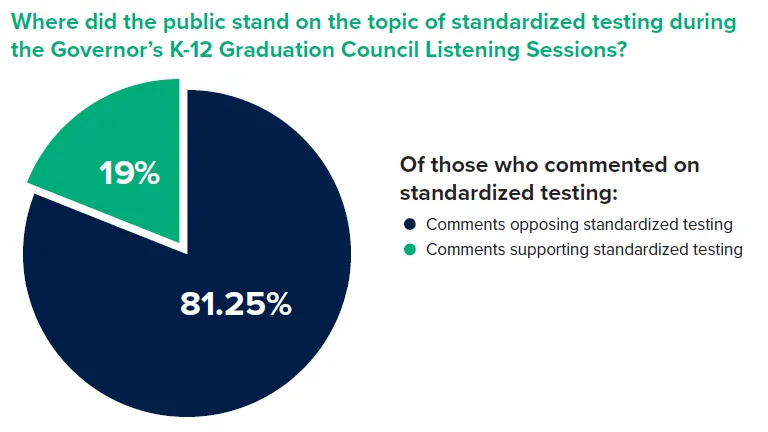
Across eight sessions, there were a total of 436 comments. Of the comments focused on standardized testing, the vast majority were opposed. Only nine comments favored standardized testing, and five of those were from one speaker. People spoke about their relief about the elimination of the MCAS as a graduation requirement, believing it was a failure, reducing “students' academic journey to a single snapshot that ignores the[ir] learning styles and backgrounds.[1] One student put it more boldly: “Stay away from MCAS."[2] Like this student, many speakers argued that the administration should move on from standardized testing, as “there are other things we can do."[3].
[1] Quote from a retired educator, May 28, 2025, listening session
[2] Student, May 28, 2025, listening session
[3] Andover educator, May 28, 2025, listening session
Where does the public stand on standardized testing?
Firmly against, based on the data from these listening sessions.
The listening sessions revealed that the public had varied ideas about changes to courses and curriculum
The listening sessions revealed that the public had varied ideas about changes to courses and curriculum used in Massachusetts schools. Comments on curriculum focused on technology, artificial intelligence, digital literacy, academic rigor, training/curriculum/standards, health education, world languages, civic education, the arts, equitable access to specialized programs, courses on diversity, equity, bias and privilege, and financial and climate literacy, with financial literacy being one of the most highly suggested course requirements. Speakers were particularly concerned about the impact of technology and AI on student learning and suggested mandating courses on digital literacy to ensure students are prepared for this changing landscape. Additionally, many comments emphasized the importance of requiring courses focused on civic education. Said one former educator: “Civic life needs to be as important, if not more, than college and career ... I don’t prepare students for civic life; I help equip them ... because they’re already involved in civic life”.[4]
[4] Former educator and current education researcher, June 25, 2025, listening session
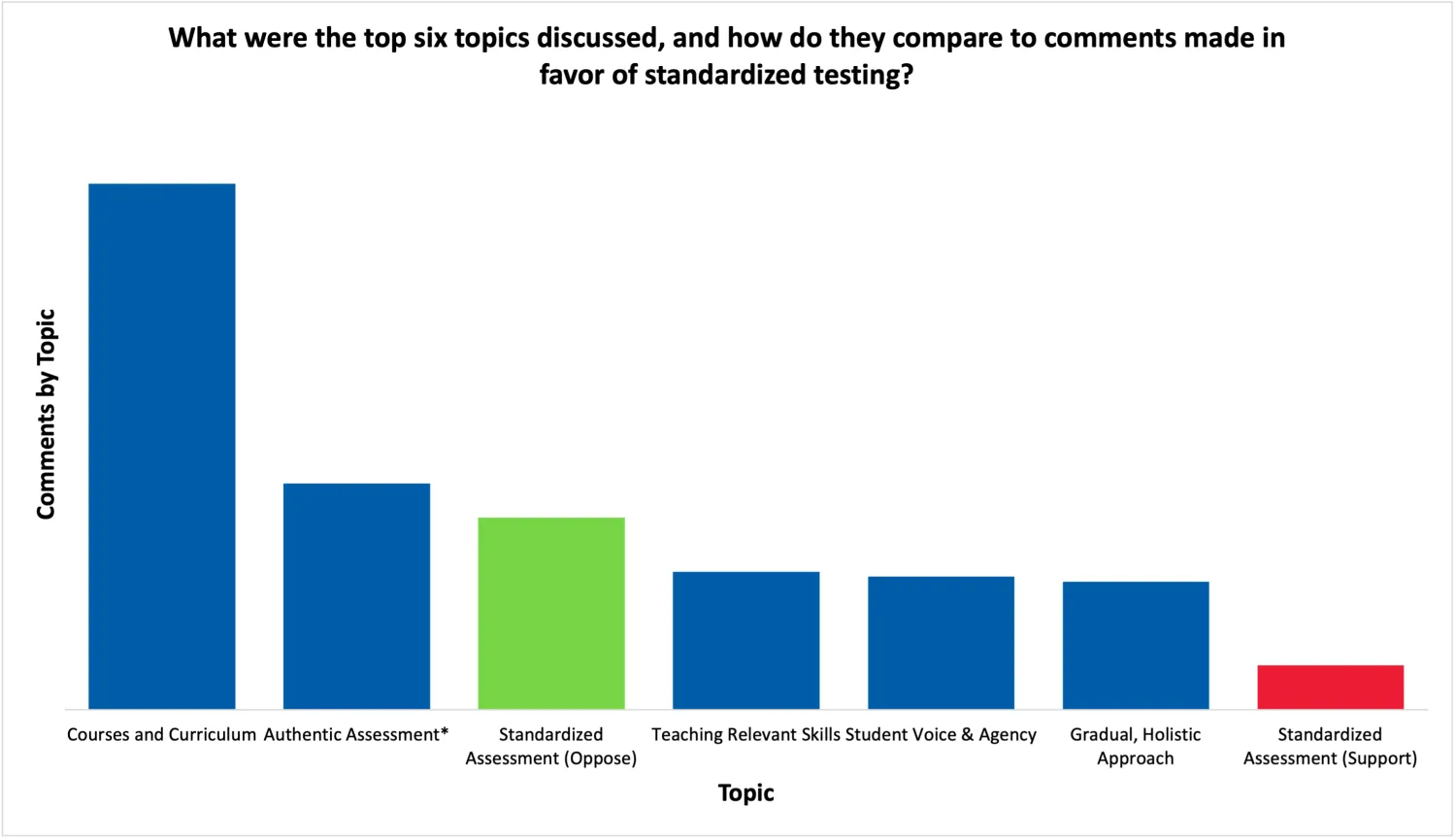
What were the top six topics discussed? And how do they compare to comments made in favor of standardized testing?
The public wants authentic assessments, not standardized tests
Authentic assessment was the next most-discussed topic, and elicited comments related to performance assessments, capstone projects and portfolios. This feedback demonstrates that the public is ready to move on from the MCAS and any other form of standardized testing the administration may seek to introduce, as such tests do not do what authentic assessments can: center around inquiry and learning and require students to apply their knowledge to real-world experiences. Regarding performance assessment, one speaker commented that “performance assessment aligns with the purpose of graduation requirements. Create opportunities for students to build skills like collaboration, problem-solving, etc. When these are organized into collections, they provide powerful, authentic demonstrations of student readiness. We value deeper learning, and we think performance assessment has the capacity to do this.”[5]
Standardized tests do not do what authentic assessments can: center around inquiry and learning and require students to apply their knowledge to real-world experiences.
[5] Speaker from MCIEA, June 3, 2025, listening session
There is a disconnect between what students are expected to know to pass standardized tests and the skills they need succeed academically and in life
Speakers voiced their concerns with the disconnect between what students are expected to know to pass standardized tests and the skills needed for both academic success and success after graduation. Many speakers maintained that students need opportunities in school to develop a variety of skills, including the ability to conduct research, to communicate effectively, to think critically, to collaborate and to network.[6] These are skills that, as one speaker explained, “can’t be assessed on a test.” The general consensus was that we should maintain high academic standards for students, while also recognizing that standardized tests often fail to measure the most critical skills our students need to be successful in college, in their careers, and as members of their communities.
[6] Anonymous speaker, April 10, 2025, listening session
Where does the public stand on standardized testing?
More than 80 percent of those who commented on standardized tests at the governor’s Graduation Requirement Council's listening sessions were opposed to using them as part of the graduation requirement.
81.25
of Comments on Standardized Tests Were Opposed to Them
Who was at these sessions?
These listening sessions included a wide range of voices; there were current, former and retired educators, parents/guardians, researchers, community leaders and students. The last session, held on June 30, 2025, was reserved solely for students to share their thoughts on a number of topics and themes. In prior sessions, however, non-students spoke about how crucial it was that the administration consider centering students’ voices to give them agency in making decisions about their education. In the June 14, 2025, session, for example, 14 people commented on involving students in not only the graduation requirements process, but in their broader educational journey. One speaker from the Youth Voice Project highlighted the consistent theme of students feeling unprepared for life after high school and not having proper support, nor resources to find this support. Another speaker implored the administration to take these listening sessions to schools because “there are not enough students in the room to make these decisions [about students].[7]
[7] A speaker from School Facts Boston, June 3, 2025 listening session
The listening sessions provided the Healey administration with more evidence that the Massachusetts public’s vote to eliminate the MCAS as a graduation requirement was the right one.
The listening sessions provided the Healey administration with more evidence that the Massachusetts public’s vote to eliminate the MCAS as a graduation requirement was the right one. The public has expansive, creative ideas about what education should look like to ensure our students are deep learners, able both to show and apply their skills and knowledge within and beyond the classroom. However, as these sessions have shown, many variables are involved in reimagining assessment and education in Massachusetts. Much of the feedback underscored the need for a gradual, holistic approach that would involve engaging more voices in the conversation to ensure high-quality education for all students. In slowing the process, Massachusetts would be aligned with other states that took a similar approach. If we want our students to be critical thinkers, community-oriented and engaged in deeper learning, the administration should take the lead in deeply thinking about implementing new graduation requirements that capture what the public wants for Massachusetts students. As one parent commented: “Reimagining graduation requirements is really reimagining our education system. What does education mean for Massachusetts?”[8] According to the public, education in Massachusetts should be authentic to students’ learning experiences, with ways to engage meaningfully in what they are learning, and providing them with different methods to show what they know and can do in ways that demonstrate they are truly prepared for post-graduate life.
“Reimagining graduation requirements is really reimagining our education system. What does education mean for Massachusetts?”
[8] Founder of a youth nonprofit organization & parent, June 3, 2025, listening session
A Diverse Union of Education Workers
The MTA represents 117,000 members in 400 local associations throughout Massachusetts. We are teachers, faculty, professional staff and Education Support Professionals working at public schools, colleges and universities across Massachusetts.