Skip Navigation
We use cookies to offer you a better browsing experience, provide ads, analyze site traffic, and personalize content. If you continue to use this site, you consent to our use of cookies.
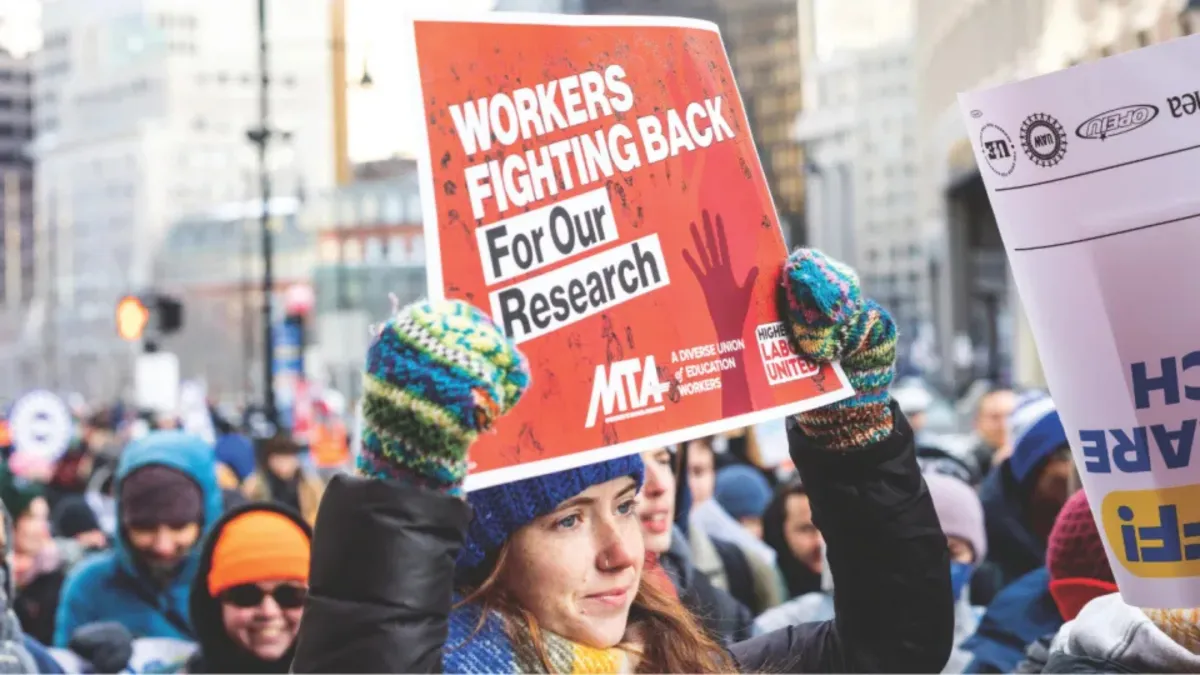
Protester holding a sign with "Workers Fight Back for Our Research" at a rally held in 2025 against the Trump administration's efforts to reduce federal research dollars to higher education.

Fighting for Our Public Colleges & Universities Higher Education

MTA higher education members work on the Amherst, Boston and Lowell campuses of the University of Massachusetts system, at nine state universities, and at 15 community colleges. They include faculty, part-time and continuing education faculty, administrators, librarians and support staff.

State report supports wage hikes for public higher education staff, faculty

A report from a state commission out today takes on the issue of properly investing in the staff and faculty at public colleges and universities for the first time and identifies providing fair wages and benefits as essential to delivering Massachusetts residents debt-free access to high-quality, public higher education.

Read

Low wages cut into campus hiring and retention

To afford living in Massachusetts, about 30 percent of campus staff work extra jobs and about half.

Faculty and staff working at public colleges and universities throughout Massachusetts are grappling with low wages that are forcing them to put off major life decisions, such as starting families, and requiring many to work multiple jobs to make ends meet.

Those were some of the findings of a survey the Massachusetts Teachers Association conducted of faculty and staff it represents at community colleges, state universities and the UMass system.

Read

Wage study shows public higher education faculty, staff salaries lagging

A salary study conducted on behalf of the MTA shows that the wages of faculty and staff, when adjusted for cost of living, are substantially below those of colleagues working at public colleges and universities in nearby states, as well as at those located in states similar to Massachusetts.


Read

Massachusetts Community College Council members, who work at Holyoke Community College, at the MTA Winter Union Skills Conference at the Sheraton Boston in January 2026.

Speaking Out for Better Pay and Working Conditions

MTA higher ed members are raising their voices and outlining their demands for better pay and working conditions. Classified staff and adjunct, contingent and part-time faculty have created a Bill of Rights with frameworks for future contracts.

Learn more

Catherine Fahey is a librarian at Salem State University. She is pictured in the middle of two shelves of books.
My goal is for all members to feel part of the union. The union is a body of members, and every member is a part of the union. If somebody disagrees with the union, they should get involved.
Quote by: Catherine Fahey, Librarian at Salem State University and member/leader of the Salem State chapter of the Massachusetts State College Association

What Educators Need to Know About 90-Credit Bachelor's Degrees 

The state Board of Higher Education opened a dangerous door for public colleges and universities, approving two proposals to earn a bachelor's degree with just 90 credits. These watered-down degrees threaten to unleash a wave of negative impacts on students, educators, and public colleges and universities.

Learn more
 

Book Examines Influence of Finance Industry on Higher Ed

Many of the critical decisions made about the way public colleges and universities operate – what types of courses are offered, how much financial aid is provided to students, the range of staff salaries and benefits – are not made on campus; they are made on Wall Street.

A book “Lend & Rule: Fighting the Shadow Financialization of Public Universities” examines the deep and troubling influence that the finance industry holds over public higher education.

Three MTA members – Rich Levy, Joanna Gonsalves and Barbara Madeloni —are among the authors of “Lend & Rule,” which looks at examples around the country of the ways in which institutional debt has become a driving force of what happens in public higher education.

The book is available to MTA members on the Libby app as part of the MTA Reads program. Instructions are available here.

Read more Download the Book

Massachusetts Teachers Association logo

A Diverse Union of Education Workers

The MTA represents 117,000 members in 400 local associations throughout Massachusetts. We are teachers, faculty, professional staff and Education Support Professionals working at public schools, colleges and universities across Massachusetts.